Kia Sonet Review 2026: Price, Mileage, Features, Variants & Buying Guide. Looking to buy the Kia Sonet? Read our in-depth Kia Sonet review covering price, variants, mileage, engine options, features, safety, performance, pros & cons, and whether it’s the right compact SUV for you.
The compact SUV segment in India has become more competitive than ever. Buyers today expect a vehicle that not only looks stylish but also delivers strong performance, advanced safety features, modern technology, and comfortable everyday usability. Among the many choices available, the Kia Sonet has consistently remained one of the most popular options because it successfully balances premium styling with practicality.
Since its launch, the Sonet has helped Kia establish itself as one of the fastest-growing automobile brands in India. Its bold design, feature-rich cabin, multiple engine options, and extensive variant lineup have made it attractive to a wide range of buyers—from first-time car owners and young professionals to small families looking for a compact yet premium SUV.
The latest Kia Sonet continues that philosophy while bringing several improvements in safety, technology, and overall refinement. Whether you’re driving through crowded city streets, cruising on highways, or planning occasional weekend road trips, the Sonet aims to offer a driving experience that feels both enjoyable and comfortable.
But is it still worth buying when competitors like the Tata Nexon, Mahindra XUV 3XO, Hyundai Venue, Maruti Suzuki Brezza, and Skoda Kylaq are fighting for the same buyers?
In this detailed review, we’ll explore everything you need to know about the Kia Sonet, including its design, cabin quality, engine choices, mileage, safety features, ride comfort, maintenance costs, and value for money to help you decide whether it deserves a place in your garage.
Kia Sonet at a Glance
| Specification | Details |
|---|---|
| Body Type | Compact SUV |
| Seating Capacity | 5 Persons |
| Fuel Options | Petrol & Diesel |
| Transmission | Manual, iMT, DCT & Automatic |
| Drive Type | Front-Wheel Drive |
| Mileage | Approximately 18–24 km/l (depending on engine and transmission) |
| Boot Space | 385 Litres |
| Fuel Tank Capacity | 45 Litres |
| Key Rivals | Tata Nexon, Hyundai Venue, Mahindra XUV 3XO, Maruti Brezza, Skoda Kylaq |
The Sonet’s biggest advantage lies in offering multiple powertrain combinations, allowing buyers to choose a version that perfectly suits their driving style and budget.
Exterior Design: Premium Styling That Still Turns Heads
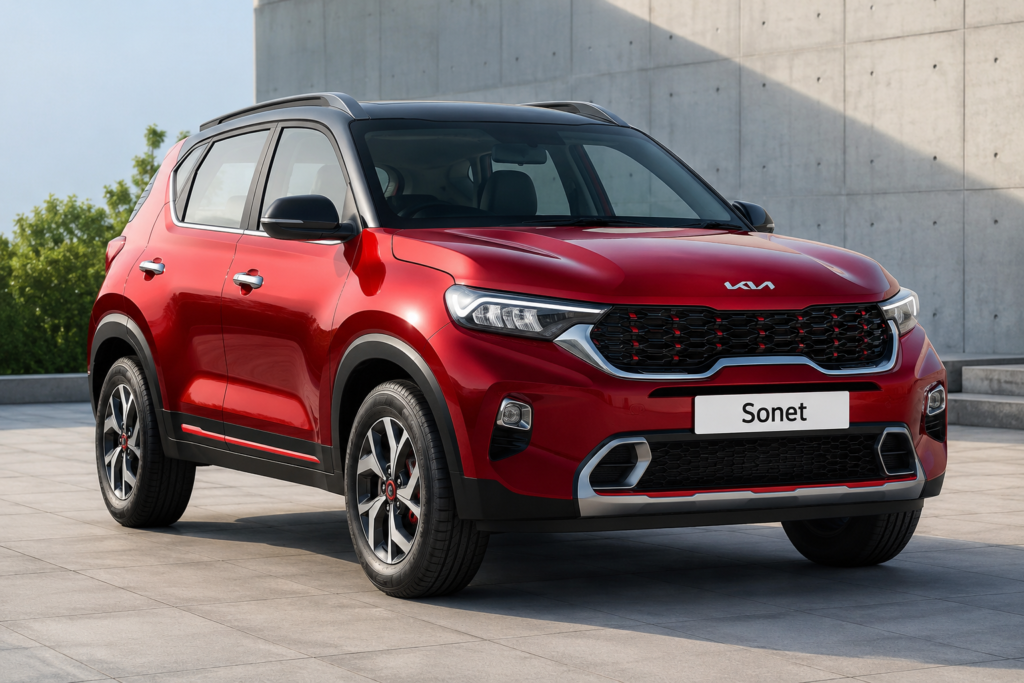
One of the strongest reasons behind the Kia Sonet’s popularity is its eye-catching design. Even after several years in the market, it continues to look fresh, modern, and premium.
Unlike many compact SUVs that follow a conservative design language, the Sonet carries a bold personality. It combines muscular proportions with premium detailing, making it appear larger than its actual dimensions.
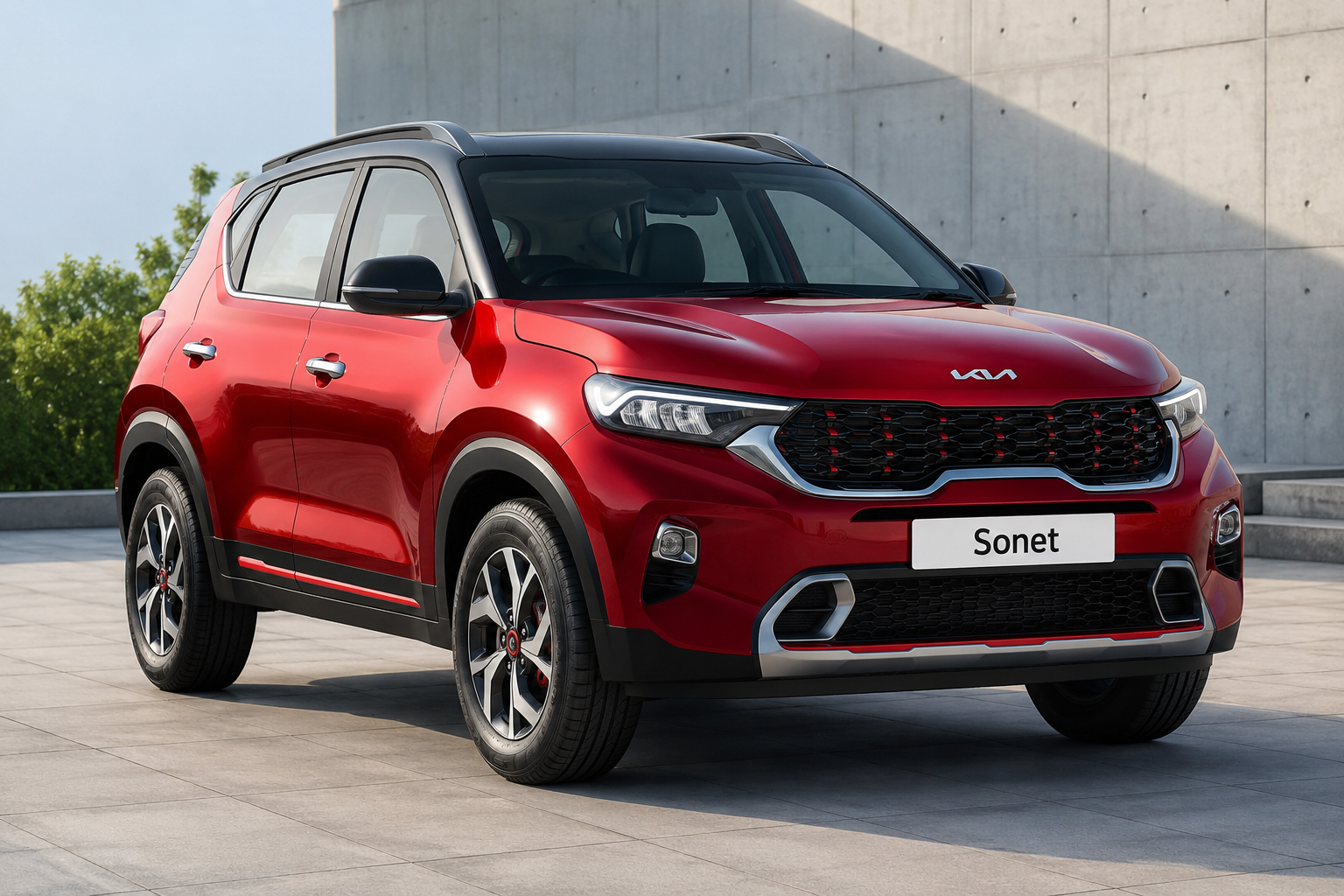
The front fascia is undoubtedly the biggest attraction. Kia’s signature digital tiger-nose grille seamlessly blends into sleek LED lighting elements, giving the SUV a wider and more aggressive appearance. The sharp bonnet lines further enhance its muscular road presence.
The redesigned LED daytime running lights create a distinctive lighting signature that is easily recognizable, especially during evening drives. Higher variants feature stylish LED projector headlamps that improve visibility while adding to the premium appeal.
Large air intakes and sporty bumper styling complete the front design without looking overdone.
From the side, the Sonet maintains clean proportions with a slightly raised stance that SUV buyers appreciate. Well-defined shoulder lines, attractive dual-tone alloy wheels, black body cladding, roof rails, and chrome accents add character without making the design feel busy.
Despite being under four metres in length, the Sonet cleverly hides its compact dimensions. Thanks to its upright stance and squared-off proportions, it appears more substantial than many rivals.
The rear design is equally impressive. Connected LED tail lamps have become a signature styling element in modern SUVs, and Kia has integrated them elegantly into the Sonet’s design. The updated rear bumper, skid plate styling, and sporty spoiler create a balanced finish.
Overall, the Sonet manages to look premium from every angle, making it one of the most stylish compact SUVs currently available.
Exterior Highlights
- Signature Digital Tiger Nose grille
- LED projector headlamps
- Connected LED tail lamps
- Stylish LED DRLs
- Premium alloy wheel designs
- Roof rails
- Shark-fin antenna
- Rear spoiler
- Silver skid plates
- High ground clearance appearance
Interior Design & Cabin Quality
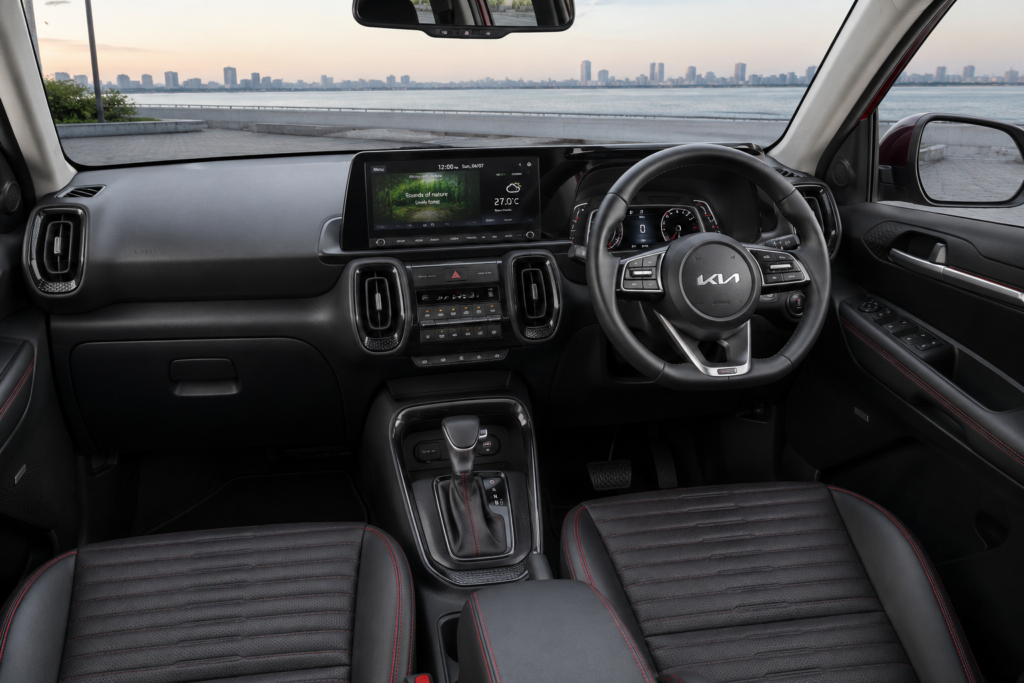
Step inside the Kia Sonet, and it becomes clear why many buyers consider it one of the most premium cabins in its segment.
Instead of focusing only on flashy features, Kia has also paid attention to the overall quality of materials, dashboard layout, and ergonomics. The result is a cabin that feels welcoming and thoughtfully designed.
The dashboard follows a clean horizontal layout that creates a sense of width. Soft-touch inserts in selected areas, textured panels, satin-finish accents, and neatly integrated air-conditioning vents give the interior an upscale appearance.
The driving position is one of the Sonet’s biggest strengths. Drivers get a commanding view of the road, making city driving easier while also boosting confidence during highway journeys.
All major controls are positioned within easy reach, reducing distractions while driving. Even first-time users can quickly become familiar with the cabin layout.
The steering wheel feels sporty and comfortable to hold, with conveniently placed multifunction controls that allow drivers to manage audio, calls, and cruise control without taking their hands off the wheel.
Front seats offer good cushioning and support for long-distance travel. The driver’s seat in higher variants comes with ventilation—a feature that remains rare in this segment and proves extremely useful during Indian summers.
Rear-seat comfort is respectable for a compact SUV. Two adults can travel comfortably, while accommodating three passengers is manageable for shorter journeys. Rear passengers also benefit from adjustable headrests, rear AC vents, USB charging ports, and sufficient knee room.
The Sonet’s 385-litre boot is practical enough for weekend luggage, grocery shopping, or airport transfers. Folding rear seats further increase cargo flexibility when carrying larger items.
Storage spaces throughout the cabin—including door pockets, cup holders, centre console storage, and seat-back pockets—enhance everyday practicality.
Interior Features That Stand Out
- Premium dashboard design
- Leatherette upholstery in selected variants
- Ventilated front seats
- Automatic climate control
- Rear AC vents
- Ambient lighting
- Wireless smartphone charger
- Push-button start
- Smart key access
- Electric sunroof (variant dependent)
- Adjustable rear headrests
- Large boot space
- Multiple USB charging options
Infotainment & Connected Technology
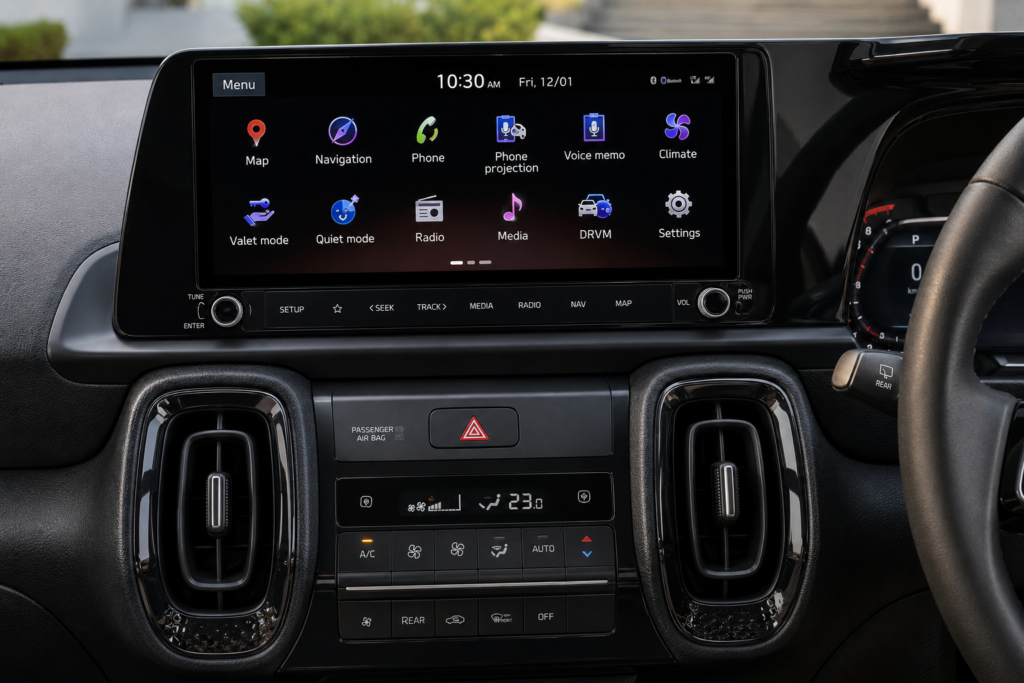
Technology has always been one of Kia’s strongest selling points, and the Sonet continues to impress in this department.
At the centre of the dashboard sits a large touchscreen infotainment system that responds quickly to inputs and offers crisp graphics. The interface is intuitive, reducing the learning curve even for users upgrading from older vehicles.
Wireless Android Auto and Apple CarPlay support allow seamless smartphone integration, enabling navigation, music streaming, messaging, and voice commands without relying on cables in compatible setups.
Music lovers will appreciate the premium Bose sound system available in higher variants. The audio quality remains rich and immersive, making daily commutes and long drives more enjoyable.
Another standout feature is Kia Connect, which introduces connected-car technology. Owners can remotely access vehicle information, locate the car, monitor driving statistics, receive maintenance reminders, and use several convenience functions through a smartphone app.
The fully digital instrument cluster provides essential driving information in a clean and modern format. Navigation prompts, trip data, fuel economy, tyre pressure information (where equipped), and safety alerts are displayed clearly for the driver.
USB Type-C charging ports, voice recognition, Bluetooth connectivity, over-the-air software support for connected functions, and steering-mounted controls further enhance the ownership experience.
Overall, the Sonet’s technology package rivals or even surpasses what some larger and more expensive SUVs offer, making it an excellent choice for buyers who prioritize convenience and connectivity.
Technology Highlights
| Feature | Availability |
|---|---|
| Large Touchscreen Infotainment | ✔ |
| Wireless Android Auto | ✔ |
| Wireless Apple CarPlay | ✔ |
| Bose Premium Audio | Higher Variants |
| Connected Car Technology | ✔ |
| Digital Instrument Cluster | ✔ |
| Voice Commands | ✔ |
| Wireless Phone Charger | ✔ |
| USB Type-C Ports | ✔ |
| Steering Mounted Controls | ✔ |
Kia Sonet Engine Options, Performance, Mileage & Driving Experience
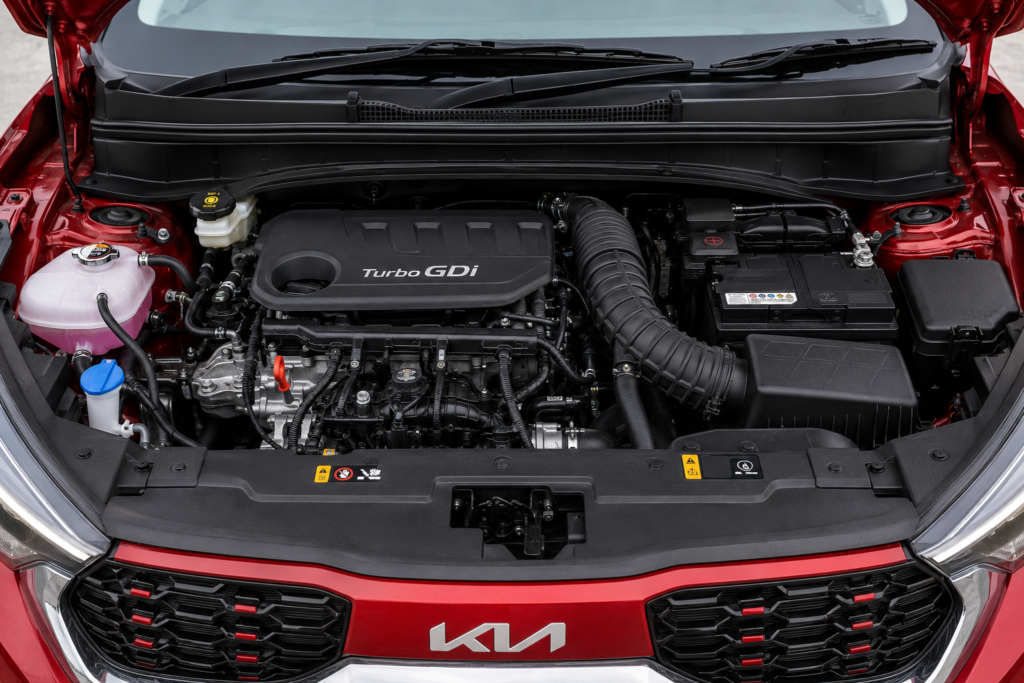
One of the biggest strengths of the Kia Sonet is the variety of engine and transmission combinations it offers. Unlike many competitors that provide only one or two powertrain choices, the Sonet caters to different driving styles and budgets. Whether you’re a city commuter, a highway enthusiast, or someone who covers long distances regularly, there’s likely a Sonet variant that fits your needs.
Instead of forcing every buyer into the same engine configuration, Kia lets you choose between naturally aspirated petrol, turbo-petrol, and diesel engines, along with manual, intelligent manual (iMT), dual-clutch automatic (DCT), and torque-converter automatic transmissions.
This flexibility makes the Sonet appealing to a broad audience, from first-time buyers looking for an economical daily driver to enthusiasts who enjoy spirited performance.
Kia Sonet Engine Options Explained
The Sonet is available with multiple engine choices, each designed for a different type of driver.
| Engine | Fuel Type | Transmission Options | Suitable For |
|---|---|---|---|
| 1.2L Naturally Aspirated Petrol | Petrol | 5-Speed Manual | City Driving |
| 1.0L Turbo GDi Petrol | Petrol | 6-Speed iMT, 7-Speed DCT | Performance & Mixed Use |
| 1.5L CRDi Diesel | Diesel | 6-Speed Manual, 6-Speed Automatic | Long Highway Trips |
Each engine has its own personality, and choosing the right one depends more on your driving habits than simply picking the most powerful option.
1.2L Naturally Aspirated Petrol Engine
If your daily driving mostly involves city traffic, office commutes, school runs, or occasional weekend outings, the 1.2-litre petrol engine is the most budget-friendly option.
Power delivery is smooth and predictable, making it easy to drive in congested urban conditions. The clutch is light, gear shifts are effortless, and the engine remains refined during normal driving.
While it isn’t designed for aggressive acceleration or high-speed performance, it performs confidently during everyday use. Beginners and first-time drivers will especially appreciate its forgiving nature.
The naturally aspirated engine also tends to have lower maintenance costs than turbocharged alternatives, making it attractive for buyers focused on long-term ownership expenses.
Best For
- Daily city commuting
- First-time car buyers
- Low annual running
- Budget-conscious families
- Easy and relaxed driving
1.0L Turbo Petrol Engine
The turbocharged petrol engine completely changes the Sonet’s driving character.
As soon as the turbo starts building boost, acceleration becomes noticeably stronger. Overtaking slower traffic requires less effort, and highway cruising feels more confident.
Despite being a small-capacity engine, it offers impressive responsiveness once you’re in the optimal rev range.
Drivers who enjoy enthusiastic driving without sacrificing fuel efficiency will appreciate this engine the most.
The turbo engine pairs well with both the Intelligent Manual Transmission (iMT) and the 7-speed Dual-Clutch Transmission (DCT), giving buyers the flexibility to choose between greater driver involvement or the convenience of an automatic.
Best For
- Young professionals
- Highway driving
- Frequent overtaking
- Buyers wanting sporty performance
- Mixed city and highway usage
1.5L Diesel Engine
For buyers who frequently travel long distances, the diesel engine remains one of the Sonet’s biggest advantages.
It produces strong low-end torque, making it effortless to drive in both city traffic and on highways. Even with passengers and luggage onboard, the engine maintains its composure without feeling strained.
The diesel engine also delivers excellent fuel efficiency, helping reduce running costs for owners with high monthly mileage.
Whether climbing hilly roads or maintaining triple-digit highway speeds, the diesel engine feels relaxed and refined.
Buyers covering more than 15,000–20,000 km annually may find the diesel variant to be the most economical choice over time.
Best For
- Highway travellers
- Long-distance commuters
- High annual mileage
- Family road trips
- Fuel economy-focused buyers
Transmission Options Explained
Kia offers four transmission choices, allowing buyers to prioritize convenience, performance, or affordability.
5-Speed Manual
The manual gearbox is smooth and beginner-friendly.
Gear shifts are precise, clutch effort remains light, and driving in city traffic doesn’t become tiring.
For buyers who enjoy greater control over gear selection, this transmission remains a solid option.
Advantages
- Lower purchase price
- Better driver involvement
- Lower maintenance costs
- Easy to repair
Intelligent Manual Transmission (iMT)
The iMT is one of Kia’s unique offerings.
Unlike a conventional manual, there is no clutch pedal. Drivers simply shift gears manually while the system automatically operates the clutch electronically.
This setup reduces fatigue in stop-and-go traffic while retaining the engagement of manual gear changes.
It provides a middle ground between a traditional manual and a full automatic.
Best For
- Urban traffic
- Drivers who dislike clutch operation
- Buyers wanting a unique driving experience
7-Speed Dual-Clutch Transmission (DCT)
The DCT is aimed at buyers who prioritize quick gear changes and a sportier driving feel.
Shifts are fast and smooth during normal driving, and the transmission responds promptly when accelerating or overtaking.
On highways, it keeps the engine in the optimal power band, contributing to both performance and efficiency.
While it excels on open roads, very slow-moving bumper-to-bumper traffic may occasionally reveal the typical characteristics associated with dual-clutch systems.
Ideal For
- Performance enthusiasts
- Highway driving
- Premium driving experience
- Frequent long-distance trips
6-Speed Automatic Diesel
The diesel automatic combines convenience with practicality.
Gear changes are smooth and well-calibrated, making it particularly suitable for city traffic while still offering relaxed highway cruising.
Unlike some automatic transmissions that prioritize quick shifts, this setup focuses on refinement and ease of driving.
For buyers seeking a comfortable family SUV, this transmission complements the diesel engine well.
Real-World Driving Experience
The Sonet feels compact enough for crowded city streets while still offering the commanding seating position buyers expect from an SUV.
Visibility from the driver’s seat is good, and the steering remains light at low speeds, making parking and U-turns relatively easy.
As speeds increase, the steering gains weight, improving confidence during highway driving.
The suspension is tuned to absorb most everyday road imperfections effectively. Speed breakers, potholes, and rough patches are handled comfortably, although sharper bumps may still be felt inside the cabin due to the Sonet’s compact dimensions.
Overall, the ride quality strikes a good balance between comfort and stability.
Highway Performance
The Sonet performs impressively on highways, especially in its turbo-petrol and diesel variants.
The turbo engine offers brisk acceleration, allowing confident overtakes without requiring excessive planning.
The diesel engine excels at maintaining steady cruising speeds, with ample torque available for climbing inclines or carrying a full load.
At legal highway speeds, the cabin remains relatively composed, enabling comfortable long-distance travel.
The braking system inspires confidence, and the SUV maintains stability even during lane changes.
Ride Comfort
Kia has tuned the suspension to suit Indian road conditions reasonably well.
Passengers enjoy a comfortable ride over most urban surfaces, and the seats provide adequate support during extended journeys.
The front seats are particularly comfortable, while rear passengers benefit from good cushioning and generous headroom.
Although the suspension leans slightly toward the firmer side, this setup contributes to better handling and reduced body roll when cornering.
Handling & Cornering
Despite its SUV styling, the Sonet handles more like a well-sorted hatchback than a bulky utility vehicle.
Body roll is controlled, steering responses are predictable, and the vehicle feels stable during quick directional changes.
It isn’t intended to be a performance SUV, but it remains enjoyable to drive, especially with the turbo-petrol engine.
Drivers transitioning from a premium hatchback will find the Sonet surprisingly confidence-inspiring.
Braking Performance
The braking system delivers reassuring stopping power under both city and highway conditions.
Pedal feel is progressive, allowing drivers to modulate braking force effectively.
Higher variants equipped with advanced safety technologies further enhance braking confidence by assisting in emergency situations.
Noise, Vibration & Refinement (NVH)
Cabin refinement is another area where the Sonet performs well.
The naturally aspirated petrol engine remains quiet during regular driving, while the turbo engine becomes more vocal only under hard acceleration.
The diesel engine produces a characteristic diesel sound during startup, but once cruising, noise levels reduce considerably.
Wind and road noise remain well controlled at moderate speeds, making long-distance travel comfortable.
Real-World Mileage Expectations
Actual fuel economy depends on driving style, traffic conditions, vehicle load, and maintenance.
| Engine | City Mileage | Highway Mileage |
|---|---|---|
| 1.2 Petrol Manual | 14–17 km/l | 18–20 km/l |
| 1.0 Turbo Petrol | 13–16 km/l | 17–20 km/l |
| 1.5 Diesel Manual | 18–21 km/l | 22–25 km/l |
| 1.5 Diesel Automatic | 17–20 km/l | 21–24 km/l |
These figures represent practical expectations under mixed Indian driving conditions rather than ideal laboratory numbers.
Which Engine Should You Choose?
Choosing the right Sonet depends on how you plan to use it.
| Buyer Type | Recommended Engine |
|---|---|
| Daily City Driver | 1.2 Petrol Manual |
| Performance Lover | 1.0 Turbo Petrol DCT |
| Office Commute + Weekend Trips | 1.0 Turbo Petrol iMT |
| High Annual Running | 1.5 Diesel Manual |
| Comfortable Family Driving | 1.5 Diesel Automatic |
| First-Time Buyer | 1.2 Petrol Manual |
| Frequent Highway Traveller | 1.5 Diesel |
The Kia Sonet’s diverse powertrain lineup ensures there’s a suitable option for nearly every type of buyer, making it one of the most versatile compact SUVs in its segment.
Kia Sonet Safety, Variants, Ownership Experience, Competitor Comparison & Verdict
A compact SUV should do more than just look attractive or offer a long list of features. It should also keep occupants safe, remain affordable to own, and continue to deliver value years after purchase. This is where the Kia Sonet has evolved significantly. The latest version brings improvements in structural safety, advanced driver assistance features on selected variants, and a broader range of equipment across the lineup.
If you’re planning to keep your next car for several years, these factors deserve as much attention as engine performance or infotainment.
Safety: A Strong Step Forward
Safety has become a major deciding factor for Indian car buyers, and Kia has responded by making the Sonet better equipped than before. While the exact feature list varies by variant, the SUV offers a comprehensive package designed to help prevent accidents and protect occupants if one occurs.
The Sonet uses a body structure engineered with a higher proportion of high-strength steel, improving rigidity while helping absorb impact energy more effectively. Alongside passive safety, several active safety technologies assist the driver during everyday driving.
Higher variants also introduce Level 1 Advanced Driver Assistance Systems (ADAS), bringing features that were once found mainly in larger and more expensive vehicles.
Key Safety Features
- Six airbags (available from selected variants and above)
- Electronic Stability Control (ESC)
- Vehicle Stability Management (VSM)
- Hill Start Assist Control
- Anti-lock Braking System (ABS)
- Electronic Brakeforce Distribution (EBD)
- Brake Assist
- Rear parking sensors
- Rear parking camera with dynamic guidelines
- Front parking sensors (selected variants)
- ISOFIX child-seat anchors
- Tyre Pressure Monitoring System (TPMS)
- All-wheel disc brakes on higher variants
- Three-point seatbelts for all passengers
- Seatbelt reminders
- High-strength body construction
These features contribute to greater confidence, whether you’re navigating city traffic, driving on highways, or carrying your family on longer journeys.
ADAS Features
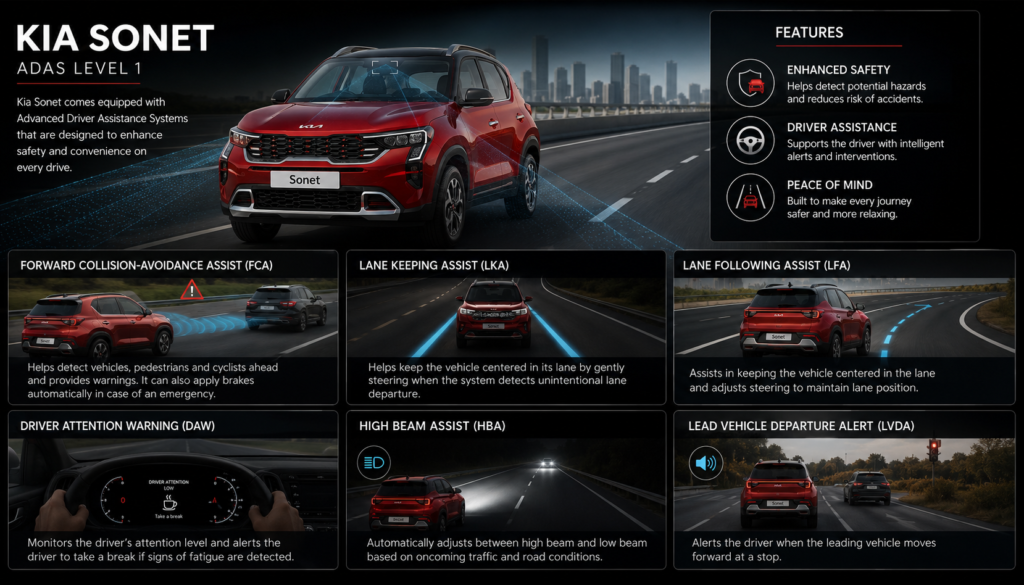
One of the Sonet’s standout highlights is the availability of ADAS (Advanced Driver Assistance Systems) in higher variants. These systems use cameras and sensors to assist the driver in certain situations. While they do not replace attentive driving, they can provide an extra layer of support.
Available ADAS features include:
- Forward Collision Warning
- Forward Collision Avoidance Assist
- Lane Keep Assist
- Lane Following Assist
- Driver Attention Warning
- High Beam Assist
- Leading Vehicle Departure Alert
These technologies are especially useful during long highway drives, where fatigue or momentary distractions can occur.
Kia Sonet Variants Explained
The Sonet is offered in multiple variants, allowing buyers to choose according to their budget and feature preferences.
HTE
The HTE serves as the entry point into the Sonet range. It focuses on the essentials, making it suitable for buyers who want Kia’s design and reliability at the lowest possible price.
Ideal for:
- Budget-conscious buyers
- First-time car owners
- Fleet or commercial users
HTK
The HTK variant adds convenience features that improve everyday usability without significantly increasing the price. It offers a better balance between affordability and equipment.
Ideal for:
- Daily commuters
- Small families
- Buyers upgrading from a hatchback
HTK+
The HTK+ is often considered one of the value-for-money options in the lineup. It introduces additional comfort and technology features that many buyers expect from a modern compact SUV.
Ideal for:
- Family buyers
- Buyers looking for better value
- Long-term ownership
HTX
The HTX takes a noticeable step toward a premium experience. It adds more advanced technology, improved interior finishes, and several convenience features that enhance daily driving.
Ideal for:
- Buyers seeking premium features
- Professionals
- Urban users
HTX+
The HTX+ includes many of the flagship-level features while remaining more affordable than the top-spec trim. It appeals to buyers who want luxury without opting for the absolute highest variant.
Ideal for:
- Feature-focused buyers
- Technology enthusiasts
GTX+
The GTX+ represents the performance-oriented and feature-rich side of the Sonet range. It combines premium styling with advanced technology and stronger powertrain options.
Ideal for:
- Enthusiastic drivers
- Highway users
- Buyers wanting the best available features
X-Line
The X-Line stands apart with its exclusive styling elements and distinctive appearance. Matte-finish exterior paint (where offered), unique trim details, and premium interior touches give it a more exclusive personality.
Ideal for:
- Buyers who want a unique look
- Premium SUV enthusiasts
- Customers prioritizing style
Which Variant Offers the Best Value?
While every buyer’s requirements differ, some variants stand out for their balance of features and price.
| Buyer Type | Recommended Variant |
|---|---|
| Budget Buyer | HTE |
| Best Value | HTK+ |
| Family Use | HTX |
| Feature Lover | HTX+ |
| Premium Experience | GTX+ |
| Exclusive Styling | X-Line |
For most private buyers, the HTK+ and HTX variants strike the best balance between affordability and equipment.
Available Colour Options
The Sonet is available in a range of colours that complement its sporty design. Availability may vary depending on the variant.
Popular choices include:
- Glacier White Pearl
- Aurora Black Pearl
- Sparkling Silver
- Gravity Grey
- Imperial Blue
- Intense Red
- Pewter Olive
- Clear White
- Xclusive Matte Graphite (X-Line)
Lighter shades highlight the SUV’s sharp design lines, while darker colours give it a more sophisticated and premium road presence.
Ownership Experience
Owning a vehicle is about more than the purchase price. Running costs, service quality, and reliability all play an important role in long-term satisfaction.
The Sonet generally offers a positive ownership experience thanks to Kia’s expanding dealership and service network across India. Routine servicing is straightforward, spare parts are widely available, and service intervals are designed to keep maintenance manageable.
Cabin quality has also proven durable in regular use, with materials that resist everyday wear reasonably well when properly maintained.
Maintenance Costs
Maintenance costs vary depending on engine choice, annual mileage, and driving conditions, but the Sonet remains competitive within the compact SUV segment.
Typical ownership expenses include:
- Periodic engine oil changes
- Air and cabin filter replacement
- Brake pad inspection and replacement
- Wheel alignment and balancing
- Tyre replacement based on wear
- Battery replacement after several years of use
Turbo-petrol engines benefit from timely servicing and the recommended engine oil, while diesel owners should ensure regular maintenance if the vehicle is frequently driven in heavy traffic.
Following the manufacturer’s maintenance schedule helps maximise performance, fuel efficiency, and long-term reliability.
Practicality for Everyday Use
Beyond specifications, the Sonet performs well in day-to-day life.
Its compact dimensions make parking easier than larger SUVs, while the elevated seating position improves visibility in traffic. The cabin offers useful storage spaces for bottles, mobile phones, wallets, and other essentials.
Rear air-conditioning vents, USB charging ports, multiple cup holders, and a practical boot enhance convenience for families and daily commuters alike.
Whether you’re driving to work, shopping, or heading out on a weekend getaway, the Sonet adapts well to a variety of situations.
Kia Sonet: Pros & Cons
Pros
- Premium and modern exterior design
- One of the best interiors in the segment
- Multiple engine and transmission options
- Smooth petrol and efficient diesel choices
- Feature-rich across higher variants
- Available ADAS technology
- Ventilated front seats
- Premium infotainment system
- Comfortable for city and highway driving
- Strong road presence
- Good resale value potential
Cons
- Rear seat width may feel tight for three adults on long journeys
- Suspension can feel slightly firm on sharp road imperfections
- Top variants become considerably more expensive
- Boot space is practical but not class-leading
- Turbo-petrol performance is best experienced in higher trims
Kia Sonet vs Competitors
The compact SUV market is highly competitive, and the Sonet faces strong rivals. Here’s how it compares.
| Feature | Kia Sonet | Tata Nexon | Hyundai Venue | Mahindra XUV 3XO | Maruti Brezza |
|---|---|---|---|---|---|
| Premium Interior | ★★★★★ | ★★★★☆ | ★★★★☆ | ★★★★☆ | ★★★☆☆ |
| Technology | ★★★★★ | ★★★★☆ | ★★★★☆ | ★★★★★ | ★★★☆☆ |
| Engine Choices | ★★★★★ | ★★★★☆ | ★★★★★ | ★★★★☆ | ★★★☆☆ |
| Diesel Option | ✔ | ✔ | ✔ | ✔ | ✘ |
| ADAS | ✔ | Limited | Limited | ✔ | Limited |
| Ride Comfort | ★★★★☆ | ★★★★★ | ★★★★☆ | ★★★★☆ | ★★★★☆ |
| Highway Performance | ★★★★★ | ★★★★☆ | ★★★★☆ | ★★★★★ | ★★★☆☆ |
| City Driving | ★★★★★ | ★★★★☆ | ★★★★★ | ★★★★☆ | ★★★★★ |
| Overall Premium Feel | ★★★★★ | ★★★★☆ | ★★★★☆ | ★★★★☆ | ★★★☆☆ |
The Sonet stands out with its premium cabin, advanced technology, and wide range of engine and transmission combinations, making it one of the most versatile options in the segment.
Who Should Buy the Kia Sonet?
The Sonet is an excellent choice if you:
- Want a compact SUV with premium styling.
- Prefer a feature-rich cabin with modern technology.
- Need multiple engine and transmission options.
- Frequently drive in both city traffic and on highways.
- Appreciate advanced convenience features like ventilated seats and connected-car technology.
- Value a balance of comfort, practicality, and contemporary design.
If your priorities are a spacious family SUV with strong road presence and a premium ownership experience, the Sonet deserves a place on your shortlist.
Final Verdict
The Kia Sonet continues to be one of the strongest contenders in India’s compact SUV segment because it successfully combines style, technology, comfort, and practicality in a well-rounded package.
Its biggest strengths are the premium-looking cabin, extensive feature list, multiple powertrain choices, and a driving experience that suits both city commutes and highway travel. The addition of advanced safety technologies and ADAS on selected variants further strengthens its appeal for modern buyers.
While some competitors may excel in specific areas—such as outright rear-seat space or softer suspension tuning—the Sonet delivers one of the most balanced overall experiences in its class.
Whether you’re a first-time SUV buyer, a young professional upgrading from a hatchback, or a family looking for a stylish and capable everyday vehicle, the Kia Sonet remains a compelling option that offers strong value across a wide range of budgets.
Frequently Asked Questions (FAQs)
1. Is the Kia Sonet a good SUV for daily city driving?
Yes, the Kia Sonet is one of the best compact SUVs for city use. Its compact dimensions make parking easy, the steering is light at low speeds, and the visibility from the driver’s seat is excellent. Automatic variants are particularly convenient in heavy traffic.
2. Which Kia Sonet variant offers the best value for money?
The HTK+ and HTX variants are generally considered the best value. They offer a good balance of comfort, technology, safety features, and pricing without the premium cost of the top-end variants.
3. Is the Kia Sonet suitable for long highway trips?
Absolutely. The turbo-petrol and diesel variants are especially comfortable for highway cruising. They provide strong overtaking performance, stable handling, comfortable seating, and good fuel efficiency for long-distance travel.
4. Which engine is better: petrol or diesel?
It depends on your driving needs.
- Choose the 1.2-litre petrol if your driving is mostly within the city and your annual mileage is relatively low.
- Choose the 1.0-litre turbo-petrol if you enjoy quicker acceleration and a more engaging driving experience.
- Choose the 1.5-litre diesel if you travel long distances frequently and want lower running costs.
5. What is the real-world mileage of the Kia Sonet?
Mileage varies based on the engine, transmission, traffic conditions, and driving style. Under typical Indian driving conditions:
| Engine | Expected Mileage |
|---|---|
| 1.2 Petrol Manual | 14–20 km/l |
| 1.0 Turbo Petrol | 13–20 km/l |
| 1.5 Diesel Manual | 18–25 km/l |
| 1.5 Diesel Automatic | 17–24 km/l |
6. Does the Kia Sonet have a sunroof?
Yes. Selected mid and top variants come with an electric sunroof. Availability depends on the variant you choose.
7. Is the Kia Sonet safe for families?
Yes. The Sonet offers several important safety features, including six airbags (on applicable variants), Electronic Stability Control (ESC), Hill Start Assist, ISOFIX child-seat mounts, Tyre Pressure Monitoring System (TPMS), rear parking sensors, and Level 1 ADAS features on higher trims, making it a reassuring choice for family use.
8. How much boot space does the Kia Sonet offer?
The Kia Sonet provides approximately 385 litres of boot space, which is sufficient for everyday luggage, grocery shopping, and weekend trips with family.
9. Is the Kia Sonet expensive to maintain?
No. Routine maintenance costs are competitive within the compact SUV segment. Regular servicing as per the manufacturer’s schedule helps keep running costs predictable and supports long-term reliability.
10. Which transmission is best in the Kia Sonet?
The best choice depends on your preferences:
- Manual – Best for buyers seeking maximum control and lower purchase cost.
- iMT – Ideal if you want manual gear changes without using a clutch pedal.
- DCT – Great for performance-focused drivers.
- Diesel Automatic – Best for relaxed city and highway driving.
11. Does the Kia Sonet support wireless Android Auto and Apple CarPlay?
Yes, selected variants support smartphone connectivity through Android Auto and Apple CarPlay. Depending on the variant and infotainment system, this may be available wirelessly or via a wired connection.
12. Is the Kia Sonet comfortable for five passengers?
The Sonet comfortably accommodates four adults. Five occupants can travel when needed, although three adults in the rear seat may find shoulder room limited on longer journeys.
13. Who are the main competitors of the Kia Sonet?
The Sonet competes with several popular compact SUVs, including the Tata Nexon, Hyundai Venue, Mahindra XUV 3XO, Maruti Suzuki Brezza, Skoda Kylaq, Nissan Magnite, Renault Kiger, and Toyota Urban Cruiser Taisor.
14. Is the Kia Sonet worth buying in 2026?
Yes. The Sonet remains a strong contender thanks to its modern styling, premium interior, multiple engine options, advanced technology, practical cabin, and wide variant lineup. It continues to offer excellent value for buyers looking for a feature-rich compact SUV.
15. Who should buy the Kia Sonet?
The Sonet is well suited for:
- First-time SUV buyers
- Young professionals
- Small families
- Daily commuters
- Highway travelers
- Buyers who value premium features and connected technology
Check out all KIA cars – Click here
Hyundai Venue – Click here
Maruti Suzuki Brezza – Click here
Nissan Magnite – Click here