The Maruti Suzuki Baleno has always occupied an interesting position in the Indian hatchback market. It is not as small and basic as an entry-level hatchback, yet it remains noticeably easier to own and run than many larger cars. Its combination of space, fuel efficiency, equipment and Maruti Suzuki’s extensive service network has made it a familiar choice for families, first-time buyers and city commuters.
The latest Baleno facelift keeps that basic formula intact but adds meaningful upgrades in areas where buyers increasingly expect more. The biggest talking points are the updated petrol engine, additional technology, ventilated front seats, wireless charging, premium audio equipment and, most importantly, a Level 2 ADAS package on the higher variants.
At the same time, the Baleno is not a car that should be judged simply by counting features. Its real appeal comes from how well its different qualities work together for everyday Indian driving.
The current ex-showroom price starts at ₹5.99 lakh and goes up to ₹9.99 lakh, depending on the variant, transmission and fuel type. The range includes petrol manual, petrol AMT and CNG manual versions.
So, is the Baleno still one of the strongest premium hatchbacks to consider?
This detailed guide looks at its price, variants, mileage, engine, performance, exterior design, interior, comfort, technology, safety, ADAS, practicality, CNG option, pros and cons, and which variant makes the most sense for different buyers.
Maruti Suzuki Baleno Price in India
The Baleno is positioned as a premium hatchback sold through Maruti Suzuki’s Nexa retail network.
Its current ex-showroom price range is:
| Variant | Petrol MT | Petrol AMT | CNG MT |
|---|---|---|---|
| Sigma | ₹5.99 lakh | — | — |
| Delta | ₹7.00 lakh | ₹7.50 lakh | ₹7.92 lakh |
| Zeta | ₹8.00 lakh | ₹8.50 lakh | ₹8.92 lakh |
| Alpha | ₹9.10 lakh | ₹9.60 lakh | — |
| Alpha (O) | ₹9.50 lakh | ₹9.99 lakh | — |
Prices are ex-showroom and can change with manufacturer updates, offers, taxes and location.
The full range currently stretches from ₹5.99 lakh to ₹9.99 lakh ex-showroom. The petrol AMT generally costs ₹50,000 more than the equivalent manual, while the CNG variants command a larger premium over their petrol-manual counterparts.
The important point here is that the Baleno’s pricing is spread quite widely. Someone looking for a relatively affordable premium hatchback can consider the Sigma, while buyers wanting technology and convenience features can move toward the Zeta or Alpha variants.
What Makes the Baleno Different?
The Baleno’s biggest strength is not one particular specification.
It is the balance.
A buyer gets:
- A relatively spacious five-seat cabin
- A large 318-litre boot
- Petrol and CNG choices
- Manual and AMT transmission options
- Strong claimed fuel-efficiency figures
- A large touchscreen on higher variants
- Automatic climate control
- Wireless smartphone connectivity
- Head-up display
- Six airbags
- 360-degree camera
- Electronic stability control
- TPMS
- Level 2 ADAS on the higher versions
- Ventilated front seats
- A wide Maruti service network
The latest version also receives a new 1.2-litre petrol engine and several equipment upgrades.
That makes the Baleno less about chasing one headline feature and more about providing a well-rounded package.
Baleno Exterior Design
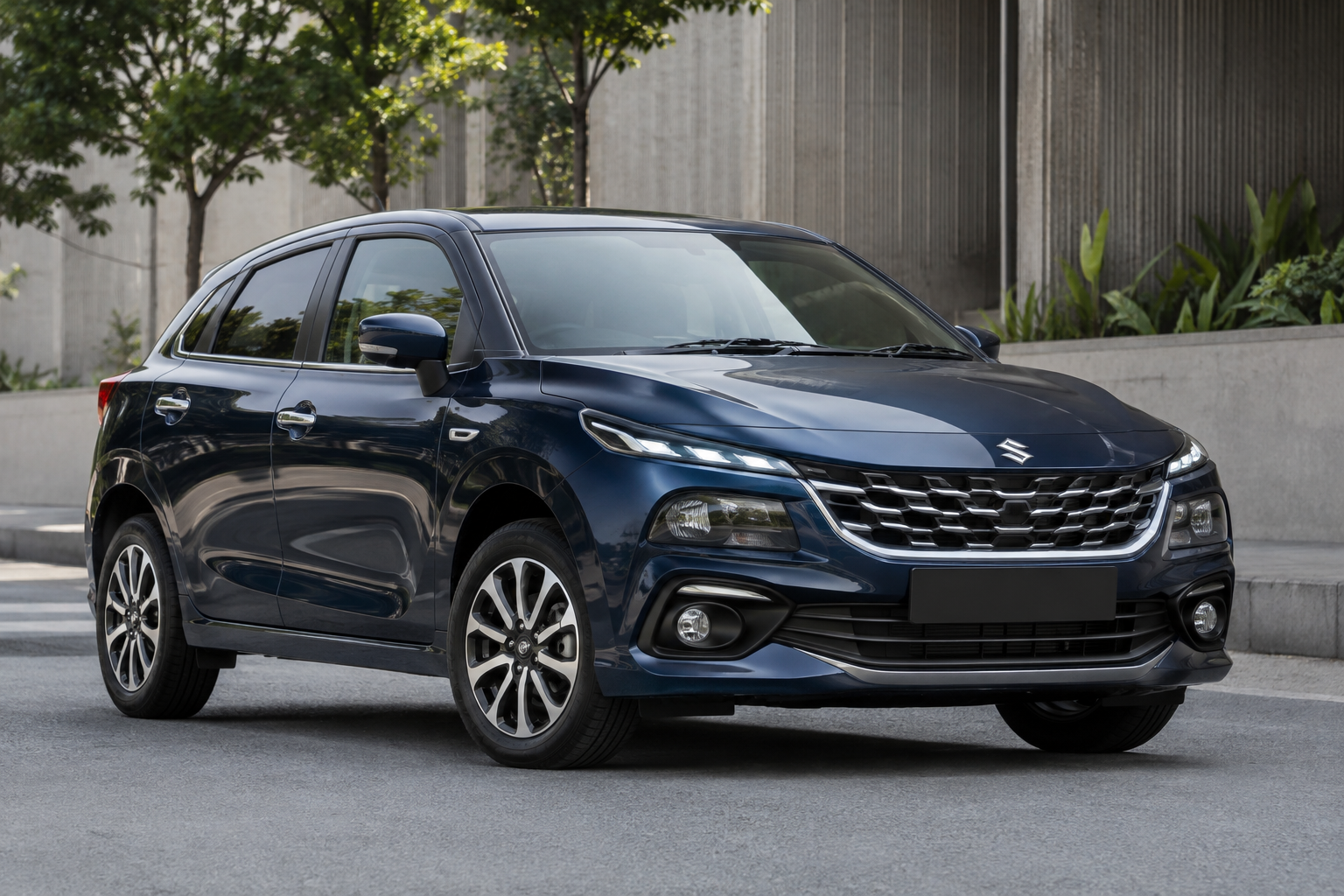
The Baleno was never designed to look like a rugged SUV, and that is actually part of its appeal.
Its proportions are unmistakably those of a premium hatchback. The body sits relatively low, the bonnet is compact, and the sloping roofline gives it a more sophisticated appearance than an ordinary small hatchback.
The latest facelift does not completely reinvent the design. Instead, the changes concentrate around the front end and small exterior details.
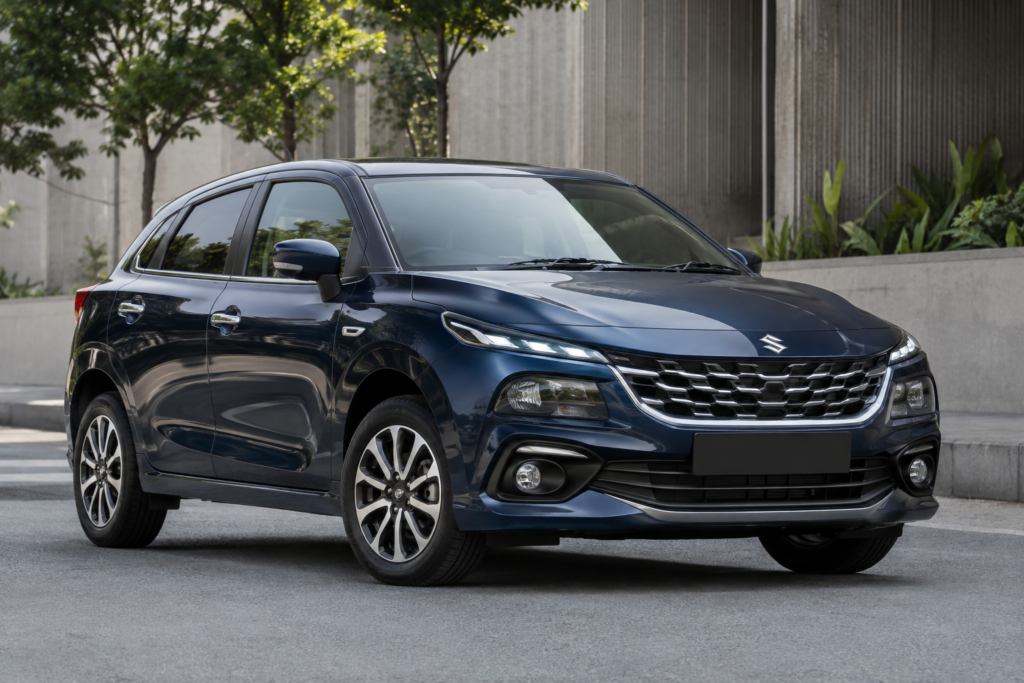
The grille is larger and gets horizontal elements, while the bumper has been revised to give the car a sharper appearance. There is also a chrome fender insert and a shark-fin antenna. A new Enigmatic Teal colour has also been added to the range.
This is an important distinction.
If you are expecting an entirely new-looking Baleno, you may find the changes relatively conservative. But if you already liked the previous design, the updated version feels more polished rather than unnecessarily dramatic.
Front-End Design
The front of the Baleno is where most of the visual changes are concentrated.
Higher variants get LED projector headlamps and LED DRLs, while the lower variants use simpler lighting equipment. The grille treatment also varies depending on the trim.
The top Alpha (O) version receives a gloss-black grille treatment with chrome detailing, giving it a more premium appearance.
The design is particularly well suited to buyers who want a sophisticated city car rather than something that tries too hard to look aggressive.
Baleno Interior and Cabin Experience
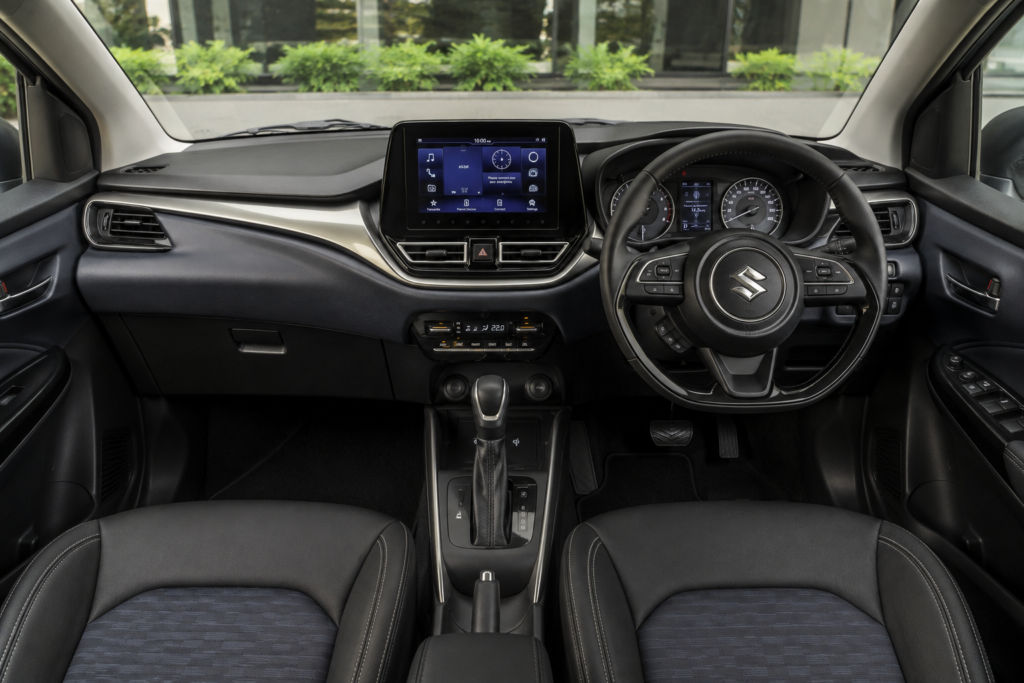
Step inside and the Baleno’s cabin continues the familiar premium-hatchback theme.
The dashboard has a flowing design with contrasting elements, while higher variants bring additional technology and comfort equipment.
One of the biggest improvements is the availability of ventilated front seats, a feature that is particularly useful in India’s hot weather. It is not something that every buyer will consider essential, but once you have experienced ventilated seats during summer, it becomes surprisingly difficult to give them up.
The updated Baleno also gets a wireless phone charger, helping reduce cable clutter around the centre console.
Other notable features include automatic climate control, wireless Android Auto and Apple CarPlay, a head-up display and a larger touchscreen on higher variants.
Is the Baleno Spacious?
For a hatchback, the Baleno has a practical cabin.
Its dimensions are approximately:
| Dimension | Baleno |
|---|---|
| Length | 3,990 mm |
| Width | 1,745 mm |
| Height | 1,530 mm |
| Wheelbase | 2,520 mm |
| Boot space | 318 litres |
| Seating capacity | 5 |
The 2,520mm wheelbase helps provide useful rear-seat space.
For two adults sitting in the back, the Baleno should be comfortable for normal journeys. Three adults can fit when necessary, although as with almost every car in this size category, three adults across the rear bench will be more comfortable for shorter journeys than long highway trips.
The cabin’s packaging is one of the reasons the Baleno works well as a family hatchback.
Baleno Boot Space
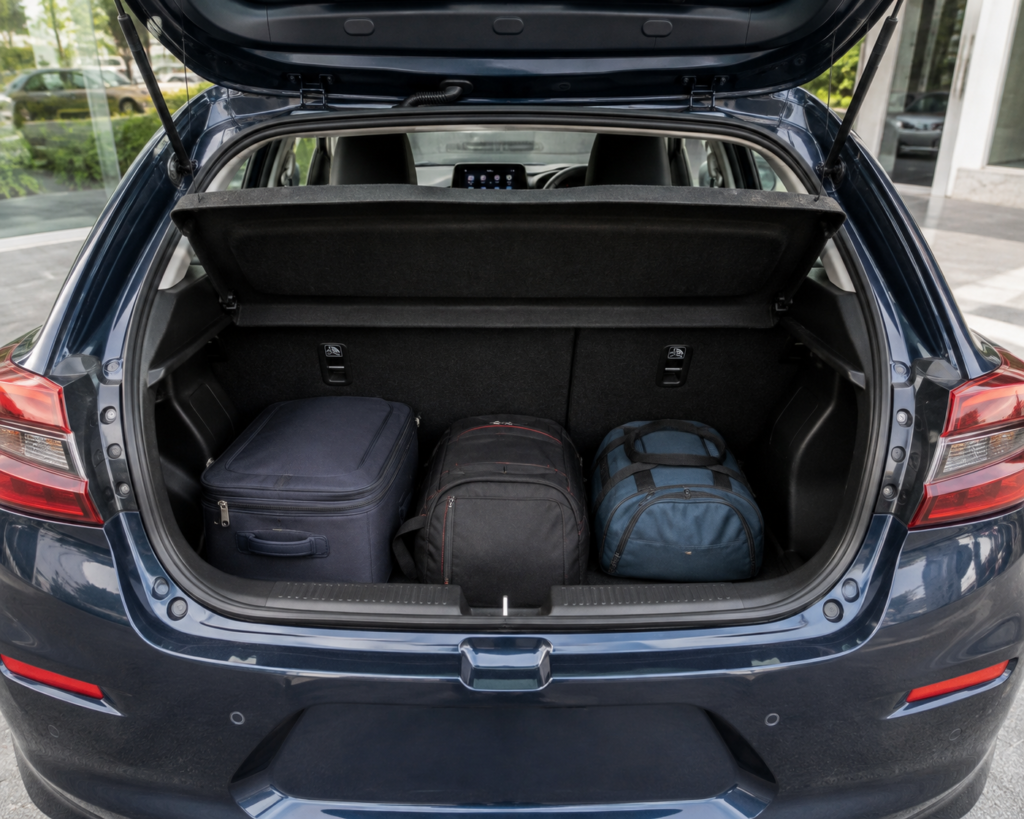
The Baleno offers a 318-litre boot.
That is enough for normal family requirements such as:
- Weekend luggage
- Grocery shopping
- Small suitcases
- Office bags
- Backpacks
- Everyday household items
For a small family, the boot should be adequate.
However, buyers who regularly carry large suitcases for four or five people may eventually find a compact SUV or sedan more suitable.
Baleno Engine and Performance
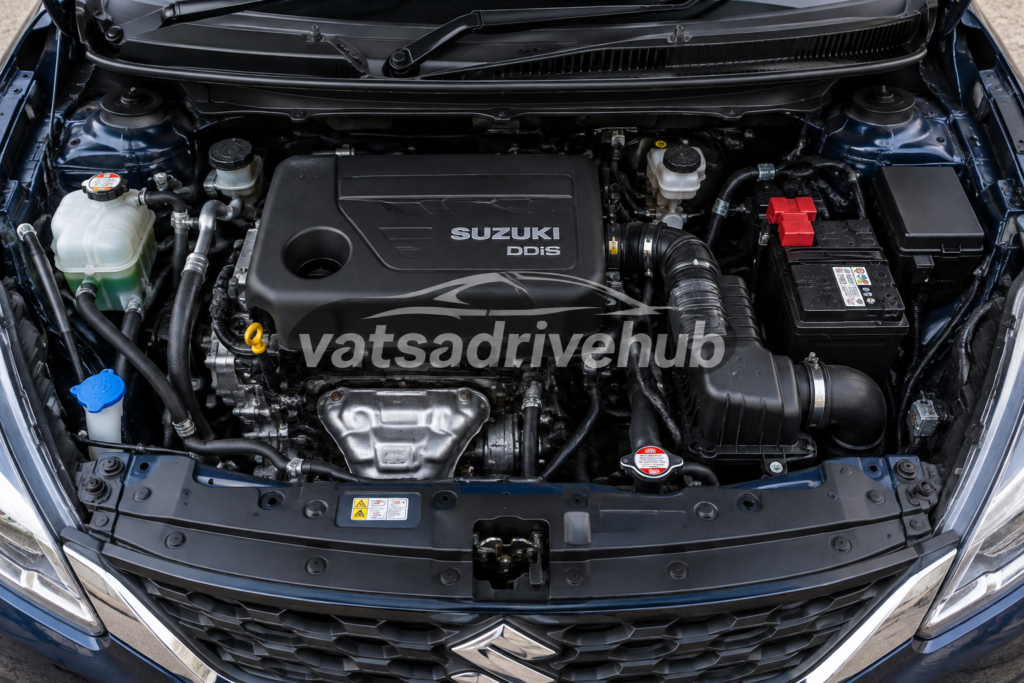
The major mechanical change is under the bonnet.
The Baleno now uses a 1.2-litre naturally aspirated petrol engine from the new Z-series family.
The petrol version produces around 83 PS and 112 Nm, while the CNG version produces around 70 PS and 102 Nm in CNG operation.
The engine can be paired with:
- 5-speed manual transmission
- 5-speed AMT
- CNG with 5-speed manual transmission
The basic mechanical philosophy is clear: efficiency and everyday usability rather than outright performance.
How Does the Baleno Drive?
If your daily driving consists mainly of city roads, the naturally aspirated petrol engine makes sense.
It does not try to deliver turbo-petrol levels of acceleration. Instead, it is designed to be predictable and relatively easy to drive.
The manual gearbox is likely to appeal to drivers who want more control over the engine’s response.
The AMT, meanwhile, is aimed at people who spend a lot of time in traffic and simply want two pedals.
That convenience comes with the usual AMT characteristic: automated manual gearboxes can feel less smooth than conventional torque-converter automatics or dual-clutch transmissions, especially during low-speed gear changes.
So the decision is fairly straightforward:
Choose the manual if driving feel and gearbox smoothness matter more.
Choose the AMT if traffic convenience is the priority.
Baleno Mileage
Fuel efficiency is one of the strongest reasons buyers consider a Baleno.
The current petrol variants are listed at around:
- 23.8 kmpl – Petrol Manual
- 24.77 kmpl – Petrol AMT
- 33.61 km/kg – CNG
These are claimed figures and should not be interpreted as guaranteed real-world mileage.
Actual mileage will depend on:
- Traffic conditions
- Driving style
- Air-conditioner usage
- Road gradient
- Vehicle load
- Tyre pressure
- Average speed
- Frequency of hard acceleration
A relaxed driver travelling mainly on open roads can generally expect better economy than someone driving aggressively through congested city traffic.
Baleno CNG: Who Should Buy It?
The CNG version deserves separate attention because it changes the ownership equation.
The Baleno CNG is available with a manual transmission and is officially rated at around 33.61 km/kg in the current listings.
It makes the most sense for buyers who drive a lot every month.
For example, consider someone commuting long distances every day. Over several years, the difference in fuel running costs can become much more important than a small difference in upfront purchase price.
But CNG is not automatically better for everyone.
You should consider:
- Availability of CNG stations along your routes
- Your monthly running
- Whether you frequently travel outside CNG-supported areas
- Your preference for manual transmission
- Additional upfront cost
If your annual mileage is low, petrol may remain the simpler choice.
Baleno Transmission Options
The Baleno offers two transmission choices with the petrol engine.
5-Speed Manual
The manual gearbox is the more traditional choice.
It suits:
- Enthusiastic drivers
- Buyers who want predictable shifts
- Highway users
- People who dislike AMT pauses
- Buyers looking for the simplest drivetrain option
5-Speed AMT
The AMT is aimed primarily at convenience.
It makes urban driving easier because you don’t need to repeatedly operate a clutch pedal.
However, buyers should test-drive it before purchasing.
Do not choose an AMT simply because it has an “automatic” badge. AMT behavior is different from the smoothness many buyers associate with conventional automatics.
Baleno Features
The feature list has become considerably stronger.
Depending on the variant, the Baleno offers:
- 9-inch touchscreen infotainment system
- Wireless Android Auto
- Wireless Apple CarPlay
- Head-up display
- Automatic climate control
- Wireless phone charger
- Ventilated front seats
- Premium Clarion audio system
- Connected-car technology
- Cruise control
- Auto-dimming inside rear-view mirror
- Rear-view camera
- 360-degree camera
- LED lighting
- Alloy wheels
- TPMS
The exact equipment varies significantly between variants, so buyers should not assume that the top-specification features are available across the entire range.
Baleno Infotainment System
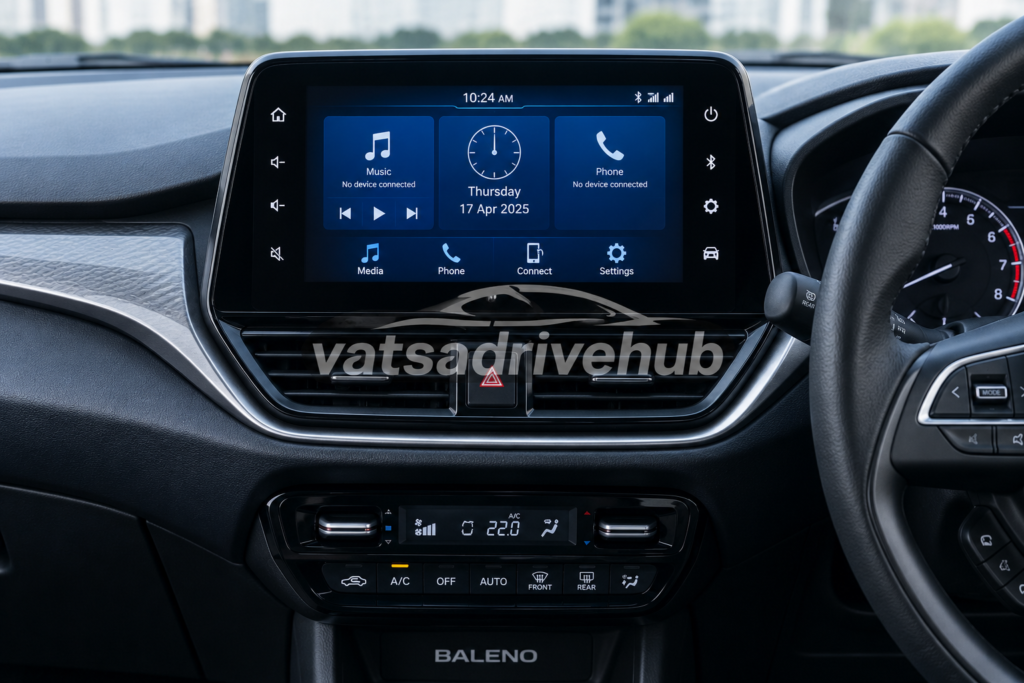
The infotainment system is one of the most visible technology upgrades.
Higher versions receive a 9-inch touchscreen, along with smartphone connectivity.
Wireless Android Auto and Apple CarPlay are especially useful because they allow the driver to access navigation, music and other compatible functions without constantly connecting a USB cable.
The top variants also receive a premium Clarion audio system.
For buyers who spend a lot of time commuting, infotainment quality can actually have a greater impact on daily satisfaction than a long list of rarely used features.
Baleno Head-Up Display
The head-up display is another interesting feature.
Instead of requiring the driver to constantly look down at the instrument cluster, selected information is projected into the driver’s field of view.
This can be useful for:
- Vehicle speed
- Navigation-related information
- Driving information
It is particularly helpful on highways because it can reduce the need to shift your eyes away from the road.
Baleno Safety Features
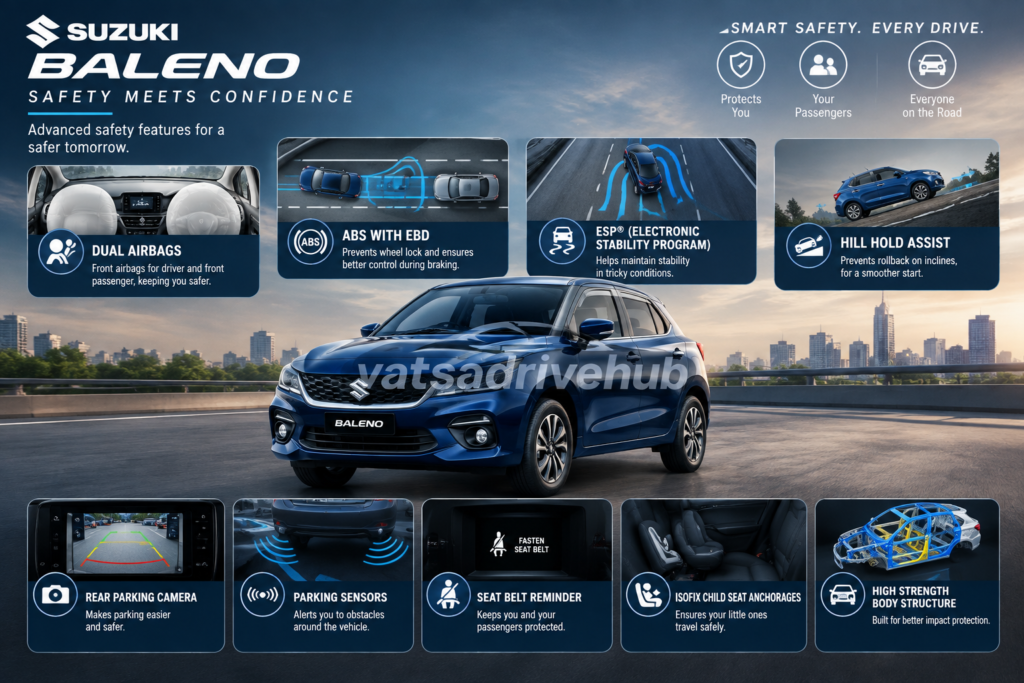
Safety has become one of the most important considerations in this segment, and the Baleno’s latest equipment list is considerably stronger.
The car offers:
- Six airbags
- ABS
- Electronic stability control
- 360-degree camera
- Rear parking sensors
- Hill-hold assist
- ISOFIX child-seat anchors
- Tyre pressure monitoring system
- Level 2 ADAS on higher variants
The availability of these systems is important because modern vehicle safety is no longer just about airbags.
Active safety systems can help the driver avoid certain situations before they become serious.
Baleno Level 2 ADAS
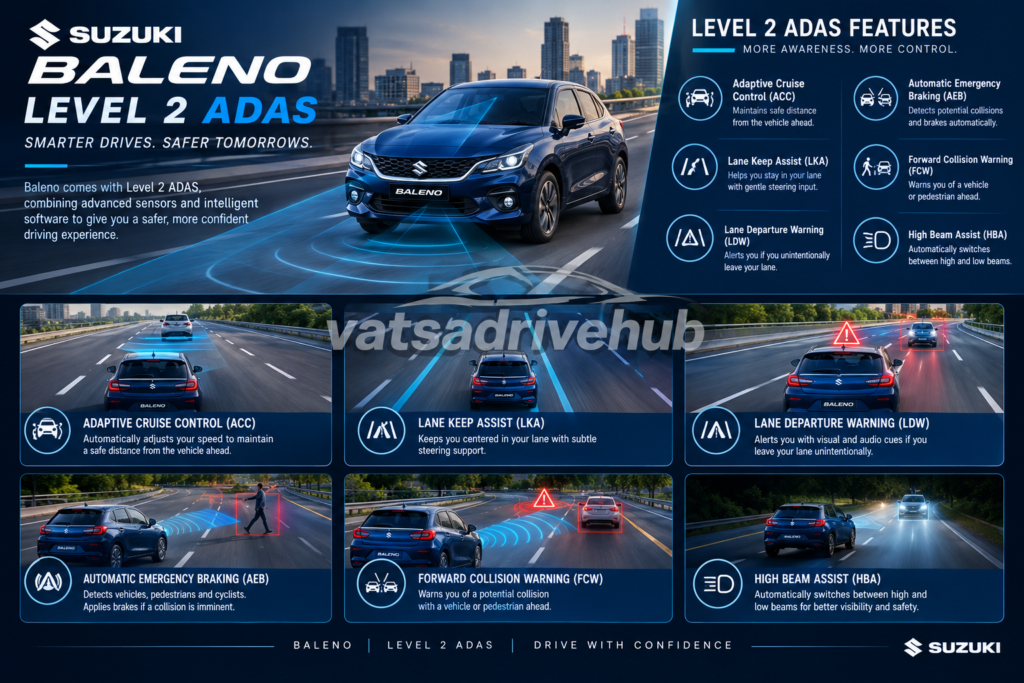
One of the biggest headlines surrounding the updated Baleno is its Level 2 ADAS package.
This is a significant addition because advanced driver assistance was previously much less common in affordable hatchbacks.
The system uses cameras and radar-based assistance for functions such as adaptive cruise control and lane-related assistance, depending on the configuration and system operation.
However, ADAS should not be treated as autonomous driving.
The driver remains responsible for controlling the vehicle.
These systems are designed to assist rather than replace the driver.
This distinction is particularly important on Indian roads, where lane markings, motorcycles, pedestrians, animals and unpredictable traffic can make automated assistance less predictable than on controlled highways.
Is ADAS Actually Useful in India?
Yes, but its usefulness depends heavily on where you drive.
On a relatively well-marked highway, features such as adaptive cruise control can reduce fatigue during long journeys.
Lane assistance can also help maintain vehicle positioning.
In dense city traffic, however, the benefit may be less consistent.
The right way to think about ADAS is:
It is an additional safety and convenience layer, not a replacement for attentive driving.
That is a healthier approach than buying a car simply because it has a “Level 2” label.
Baleno Ride and Handling
The Baleno’s setup is aimed primarily at comfort.
For everyday urban roads, this is a sensible approach.
Indian roads frequently include:
- Speed breakers
- Broken patches
- Expansion joints
- Uneven surfaces
- Potholes
- Rough side roads
A premium hatchback needs to handle these without becoming tiring.
It is not intended to be a sporty hatchback in the traditional sense.
Instead, it prioritises comfort and easy driving.
Baleno for Highway Driving
The Baleno can make sense as a highway car, especially for small families.
Its relatively compact dimensions make it easy to position on narrow roads, while the cabin and boot provide enough practicality for weekend trips.
The naturally aspirated engine does mean that overtaking requires some planning, particularly when the car is fully loaded.
This is not necessarily a problem.
You simply need to drive it according to what the engine is designed to do.
Maintain adequate revs before an overtake and avoid expecting turbo-petrol-style instant torque.
Baleno for City Driving
This is arguably where the Baleno feels most natural.
Its compact exterior dimensions, light driving characteristics and fuel-efficient engine make it suitable for daily commuting.
The AMT can make stop-and-go traffic less tiring.
The higher variants also add equipment that becomes useful during everyday use:
- Automatic climate control
- Wireless smartphone connectivity
- Rear camera
- 360-degree camera
- Wireless charging
- Cruise control
- Head-up display
This makes the Baleno more than just a fuel-saving commuter.
Baleno Variants Explained
Choosing the correct variant is arguably more important than simply knowing the maximum number of features.
The range currently consists of Sigma, Delta, Zeta, Alpha and Alpha (O), with different powertrain combinations.
Baleno Sigma
The Sigma is the entry point.
It is suitable for buyers who want:
- The Baleno’s basic space and dimensions
- Petrol manual powertrain
- Core safety equipment
- A lower purchase price
But it is not the variant for someone chasing premium technology.
If your budget is tight and you mainly want a reliable family hatchback, Sigma can make sense.
Baleno Delta
Delta is where the package becomes more complete.
It adds equipment such as:
- Better infotainment
- Smartphone connectivity
- Rear AC vents
- USB ports
- TPMS
- Power-adjustable/folding ORVMs
- Front centre armrest
For many buyers, Delta is a much more sensible starting point than Sigma because the additional equipment improves daily usability.
Baleno Zeta
Zeta is arguably one of the most interesting versions for feature-conscious buyers.
Depending on configuration, it adds:
- LED projector headlamps
- LED DRLs
- 9-inch infotainment
- Wireless phone charger
- Connected-car technology
- Alloy wheels
- Rear camera
- Better instrument display
If you want the Baleno to feel genuinely premium without automatically spending top-variant money, Zeta deserves serious consideration.
Baleno Alpha
Alpha brings more premium equipment.
Features include items such as:
- Head-up display
- Cruise control
- Auto-dimming IRVM
- Ventilated front seats
- Clarion audio system
- Leatherette seats
- 360-degree camera
- Premium alloy wheels
This is the version aimed at buyers who don’t want to compromise much on equipment.
Baleno Alpha (O)
Alpha (O) sits at the top of the range.
It combines the highest level of equipment with the automatic transmission option and pushes the price close to ₹10 lakh ex-showroom.
The question is not whether it is the most feature-rich.
It is.
The question is whether you will actually use enough of those features to justify the extra money.
For some buyers, yes.
For others, the Zeta or Alpha may provide a better balance.
Which Baleno Variant Should You Buy?
Here is the simplest way to approach the decision.
| Buyer type | Variant worth considering |
|---|---|
| Lowest possible entry price | Sigma |
| Better everyday equipment | Delta |
| Best feature/value balance | Zeta |
| Premium equipment | Alpha |
| Maximum features | Alpha (O) |
| High monthly running | Delta/Zeta CNG |
| Heavy city traffic | Delta/Zeta/Alpha AMT |
| Driver-focused manual buyer | Delta/Zeta/Alpha MT |
My value-oriented pick would be Zeta, while buyers with a tighter budget should examine Delta carefully.
The top Alpha (O) makes sense mainly when you specifically want the additional comfort, technology and ADAS-related equipment.
Baleno vs Hyundai i20
The Hyundai i20 remains one of the Baleno’s most obvious alternatives.
The two cars appeal to similar buyers but have slightly different personalities.
The Baleno’s strongest arguments are:
- Fuel efficiency
- Interior space
- Boot practicality
- Feature balance
- CNG availability
- Maruti service network
The i20 counters with its own premium cabin appeal and a different driving character.
Instead of declaring one car universally better, buyers should compare the exact variants at similar prices.
If running cost and practicality are your biggest priorities, the Baleno becomes particularly compelling.
Baleno vs Tata Altroz
The Tata Altroz is another important rival.
The Altroz has traditionally appealed to buyers who place strong emphasis on styling, cabin feel and Tata’s safety-oriented positioning.
The Baleno’s major strengths include:
- Fuel economy
- Lightweight driving experience
- CNG availability
- Wide service reach
- Large cabin for the class
Again, a test drive is important.
The best car depends on what matters most to you rather than which model has the longer specification sheet.
Baleno vs Toyota Glanza
The Toyota Glanza is closely related to the Baleno, so the comparison is somewhat different from comparing two independently engineered cars.
Buyers can consider factors such as:
- Dealer experience
- Warranty/service package
- Pricing
- Offers
- Personal preference for the brand
Mechanically, the two models are closely connected.
For someone deciding between them, it makes more sense to compare the actual deal available from the local dealer rather than choosing solely on appearance.
Baleno Pros and Cons
What I Like About the Baleno
Spacious cabin
The interior makes good use of the available dimensions.
Large boot
The 318-litre boot is useful for family duties.
Fuel efficiency
The claimed figures are a major attraction, especially for high-mileage users.
CNG option
The CNG variant makes the car interesting for buyers with high monthly running.
Feature list
The higher versions offer equipment that was once associated with considerably more expensive cars.
ADAS
The availability of Level 2 ADAS gives the Baleno a significant technology advantage in its segment.
Comfortable everyday character
The car is designed more for easy daily use than aggressive driving.
What Could Be Better?
AMT behaviour
The AMT may not feel as smooth as more sophisticated automatic transmissions.
Engine performance
The naturally aspirated engine prioritizes efficiency rather than strong acceleration.
Top variant pricing
Once you approach ₹10 lakh ex-showroom, buyers have a much wider selection of cars to consider.
ADAS dependence on road conditions
Advanced assistance is useful, but Indian road conditions can limit how consistently some functions work.
No turbo-petrol option
Performance-oriented buyers may want a stronger engine.
Is the Baleno Good for a Family?
Yes.
In fact, family buyers are among the strongest reasons the Baleno exists in this segment.
It offers:
- Five seats
- Decent rear-seat room
- Large boot
- Good fuel economy
- CNG availability
- Automatic option
- Useful safety equipment
- Comfortable ride
- Wide service network
For a family of three or four, the Baleno can comfortably handle daily commuting, school runs, office travel, shopping and weekend trips.
Is the Baleno Good for First-Time Car Buyers?
It can be an excellent first car.
The dimensions are manageable, fuel economy is attractive and maintenance/service access is a major consideration for new owners.
A first-time buyer should, however, avoid spending money on features simply because they sound impressive.
For example, if your budget is limited, it may be better to buy a well-equipped mid variant rather than stretching financially for the top trim.
A car should fit comfortably within your overall budget.
Is the Baleno Worth Buying?
The answer is yes, for the right buyer.
The Baleno makes the strongest case for itself when your priorities are:
- Fuel efficiency
- Interior space
- Everyday comfort
- Reasonable purchase price
- Low running costs
- Practicality
- Modern features
- CNG availability
- Easy city driving
It becomes less attractive if your main priority is:
- Fast acceleration
- Enthusiastic handling
- SUV-like ground clearance
- A premium automatic gearbox
- A powerful turbo engine
In other words, the Baleno is not trying to be everything.
It is trying to be a sensible premium hatchback that is easy to live with.
And that remains its biggest strength.
Final Verdict
The latest Baleno is an interesting example of how a successful hatchback can evolve without losing its original purpose.
Instead of completely changing the formula, Maruti Suzuki has concentrated on areas that matter to modern buyers: efficiency, technology, comfort and safety.
The new petrol engine keeps the focus on everyday economy, while the CNG option gives high-mileage users another route. The AMT provides convenience for city drivers, although those expecting the smoothness of a conventional automatic should take a proper test drive first.
Inside, features such as ventilated seats, wireless charging, a 9-inch touchscreen, head-up display and premium audio make the higher variants feel substantially more sophisticated.
The biggest talking point, however, is the addition of Level 2 ADAS.
It does not turn the Baleno into a self-driving car, but it does bring advanced driver-assistance technology into a price segment where such equipment is still relatively unusual.
For most buyers, I would not automatically recommend the most expensive version.
The Delta makes sense for budget-conscious buyers who want a more complete everyday package, while the Zeta is arguably the sweet spot for someone who wants a good combination of features and price.
The Alpha is better suited to buyers who value comfort and technology, while the Alpha (O) is for those who want the fullest equipment package and are comfortable spending close to ₹10 lakh ex-showroom.
Overall, the Baleno remains a strong choice for someone looking for a comfortable, spacious, efficient and feature-rich premium hatchback for everyday Indian driving.
Frequently Asked Questions About Maruti Suzuki Baleno
1. What is the price of the Baleno?
The Baleno is currently priced from ₹5.99 lakh to ₹9.99 lakh ex-showroom, depending on variant and powertrain.
2. What is the mileage of the Baleno?
The listed claimed efficiency is around 23.8 kmpl for petrol manual, 24.77 kmpl for petrol AMT and 33.61 km/kg for CNG. Real-world mileage varies according to driving conditions.
3. Does the Baleno have a CNG option?
Yes. CNG is available with selected variants and is paired with a manual transmission. The listed claimed efficiency is around 33.61 km/kg.
4. Does the Baleno have an automatic transmission?
Yes. Petrol variants are available with a 5-speed AMT.
5. Does the Baleno have ADAS?
Yes. The higher variants offer a Level 2 ADAS package.
6. How many airbags does the Baleno have?
The current Baleno is equipped with six airbags.
7. Does the Baleno have a 360-degree camera?
Yes, a 360-degree camera is available on higher variants.
8. Does the Baleno have ventilated seats?
Yes. Front-seat ventilation is available on higher variants.
9. Does the Baleno have a sunroof?
No. A sunroof is not currently listed among the Baleno’s features.
10. How big is the Baleno’s boot?
The Baleno has a 318-litre boot.
11. Is the Baleno good for long drives?
Yes. Its comfortable ride, spacious cabin and efficient engine make it suitable for long-distance travel. However, buyers looking for strong overtaking performance should remember that the naturally aspirated engine is tuned more toward efficiency than outright power.
12. Which Baleno variant offers the best value?
The Zeta is worth considering for buyers who want a strong mix of technology, comfort and price. Budget-conscious buyers should also consider Delta.
13. Is the Baleno suitable for city driving?
Yes. Its compact dimensions, efficient engine and optional AMT make it well suited to urban commuting.
14. Is the Baleno a good family car?
Yes. The spacious cabin, five-seat layout, 318-litre boot, fuel-efficient engine and available safety technology make it a practical family hatchback.
15. Is the Baleno worth buying?
For buyers prioritizing fuel economy, practicality, features, comfort and easy everyday ownership, the Baleno remains a strong option in the premium hatchback segment.
Check out all Maruti Suzuki cars – Click here
Hyundai Exter vs Maruti Fronx – Click here
Nissan Magnite detailed review – Click here
Mahindra XUV 3XO price & Mileage – Click here