Mahindra Bolero 2026 Price, Mileage, Features, Variants & Review. Mahindra Bolero 2026 price starts at ₹8.49 lakh. Check its mileage, 1.5L diesel engine, features, safety, variants, dimensions, performance and whether the Bolero is worth buying.
The Mahindra Bolero is one of those SUVs that does not need an introduction in many parts of India.
You will find it on village roads, in small towns, on rough rural tracks, outside farms, at construction sites and sometimes doing family duty on highways. While newer SUVs have moved heavily towards premium interiors, large screens and urban-friendly driving manners, the Bolero has continued to follow a much simpler philosophy: build a tough vehicle, give it a torquey diesel engine and make it capable of dealing with Indian roads without asking for too much attention.
That formula may sound old-fashioned in 2026, but surprisingly, it still works.
The current Mahindra Bolero is priced from ₹8.49 lakh to ₹9.99 lakh ex-showroom, depending on the variant. It is available with a 1.5-litre turbo-diesel engine, five-speed manual gearbox and rear-wheel-drive layout. The SUV is offered in four variants: B4, B6, B6 Opt and B8.
But the interesting question isn’t simply whether the Bolero is cheap or rugged.
The real question is:
Does the old-school Bolero still make sense when buyers today have access to much more modern SUVs?
The answer depends heavily on how and where you plan to use it.
If your priority is a comfortable urban SUV loaded with technology, the Bolero isn’t the obvious choice. But if you want a straightforward seven-seater with a diesel engine, rear-wheel drive, a ladder-frame construction and the ability to tolerate bad roads, the Bolero continues to have a very specific appeal.
Let’s take a detailed look.
Mahindra Bolero 2026: Quick Overview
| Specification | Mahindra Bolero |
|---|---|
| Engine | 1.5-litre turbo-diesel |
| Engine capacity | 1493cc |
| Cylinders | 3 |
| Maximum power | Around 75-76hp |
| Maximum torque | 210Nm |
| Transmission | 5-speed manual |
| Drive type | Rear-wheel drive |
| Seating capacity | 7 |
| Fuel type | Diesel |
| Claimed mileage | Around 16-16.5kmpl |
| Body type | SUV |
| Chassis | Ladder-frame |
| Ground clearance | 180mm |
| Variants | B4, B6, B6 Opt, B8 |
| Ex-showroom price | ₹8.49 lakh-₹9.99 lakh |
Mahindra Bolero 2026 Price in India
The current Mahindra Bolero range starts at ₹8.49 lakh ex-showroom and goes up to ₹9.99 lakh ex-showroom.
Here is the complete variant-wise pricing:
| Variant | Fuel | Transmission | Ex-showroom Price |
|---|---|---|---|
| Bolero B4 | Diesel | 5-speed Manual | ₹8.49 lakh |
| Bolero B6 | Diesel | 5-speed Manual | ₹9.29 lakh |
| Bolero B6 Opt | Diesel | 5-speed Manual | ₹9.69 lakh |
| Bolero B8 | Diesel | 5-speed Manual | ₹9.99 lakh |
Mahindra’s own online buying portal confirms these four variants and their current listed prices.
Keep in mind that these are ex-showroom prices. Your actual on-road price will be higher after adding registration, insurance, taxes and other applicable charges. Mahindra itself notes that displayed prices are indicative and can change, with the final dealership invoice determining the applicable price.
Mahindra Bolero Design: Still Boxy, Still Recognisable
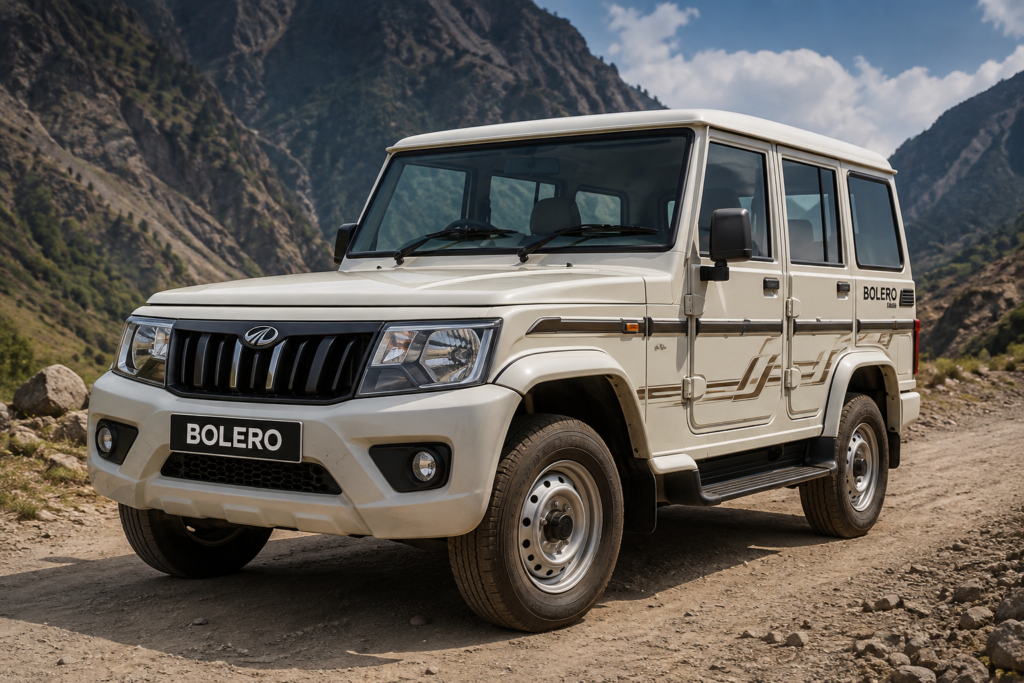
If you park a Bolero next to a modern compact SUV, the difference in design philosophy becomes obvious immediately.
Most contemporary SUVs try to look sleek, aerodynamic and sophisticated.
The Bolero doesn’t seem particularly interested in any of that.
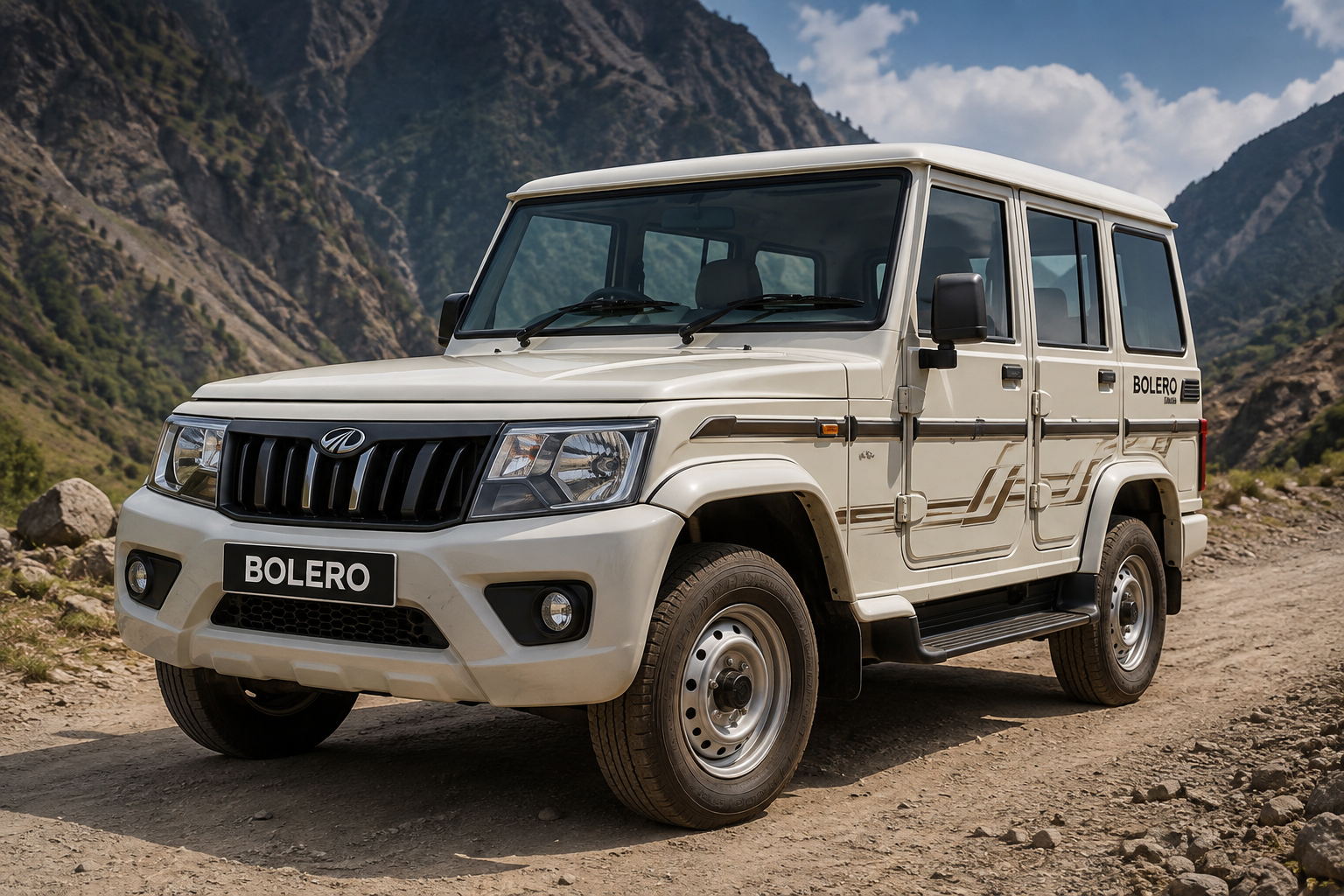
It remains upright, square and deliberately rugged.
The front gets a large grille with chrome detailing, squared-off headlamp units and a chunky bumper. The overall face gives the SUV a substantial presence despite its compact dimensions.
The side profile is even more traditional.
You get a tall body, large windows, prominent wheel arches and a fairly straight roofline. The design doesn’t attempt to hide its utilitarian roots. In fact, that’s one of the reasons the Bolero has developed such a recognisable identity over the years.
At the rear, the externally mounted spare wheel immediately tells you that this isn’t intended to be a soft urban crossover.
The tailgate-mounted spare wheel, tall tail lamps and upright rear profile give the Bolero a distinctly traditional SUV appearance.
Mahindra Bolero Colours
The current Bolero is offered in four colour choices:
- Stealth Black
- Diamond White
- DSAT Silver
- Rocky Beige
Mahindra’s official configurator lists these four colours.
The Stealth Black shade is arguably the most understated choice because it avoids some of the contrasting exterior detailing that is more noticeable on the lighter colours.
Diamond White, meanwhile, suits the Bolero’s traditional character particularly well.
Mahindra Bolero Interior: Functional Rather Than Fancy
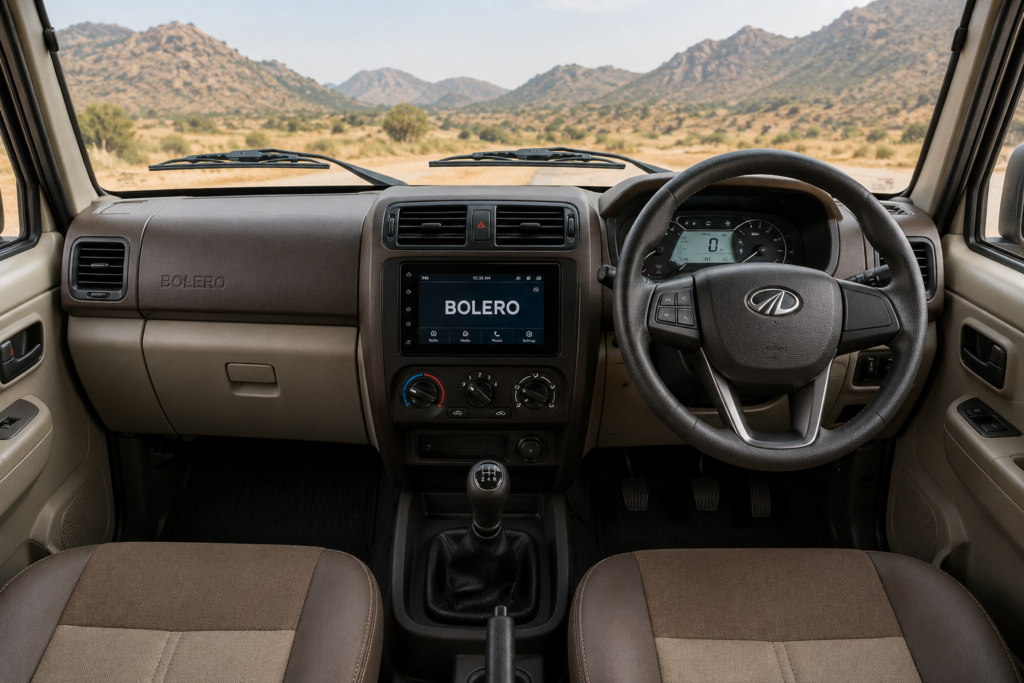
Step inside the Bolero and you immediately realise where Mahindra has chosen to spend its money.
This isn’t an interior designed to impress someone browsing through an SUV showroom.
It is designed to be straightforward.
The dashboard has a relatively upright layout with a dual-tone theme. Controls are large enough to operate without much thought, and the overall arrangement prioritises functionality.
That approach makes sense for a vehicle intended to be used in environments where simplicity can actually be an advantage.
There aren’t layers of menus to navigate.
There isn’t an overwhelming collection of touch-sensitive controls.
Instead, most of the important functions are easy to understand.
That’s one area where the Bolero clearly shows its age.
A buyer coming from a modern compact SUV may find the cabin basic.
But a buyer looking at the Bolero primarily as a rugged family/work vehicle may not consider that a deal-breaker.
Front Seat Comfort
The front seats offer a reasonably spacious seating environment, particularly in terms of headroom and overall cabin space.
The tall body gives the driver a commanding view of the road.
This is one of the Bolero’s strengths.
You sit relatively high, you can see the surroundings clearly and the upright shape makes the vehicle feel substantial.
However, the driving position isn’t perfect.
The lack of steering adjustment and limited seat adjustment can make it harder for shorter drivers to find an ideal driving position.
Getting inside also requires a bit more climbing than you would expect from a typical modern compact SUV.
The side step helps, but the Bolero’s tall body is noticeable.
For older passengers, this can be worth considering before buying.
Second Row: Where the Bolero Makes More Sense
The second row is considerably more useful than the third row.
There is decent headroom and legroom, while the relatively flat floor makes the middle position more usable.
For a family that regularly carries five people, the Bolero can therefore work reasonably well.
The cabin’s width also means three passengers can sit across the second row without feeling excessively cramped.
That said, comfort expectations should remain realistic.
This isn’t a plush three-row SUV.
It’s a rugged utility-oriented vehicle that happens to offer seven seats.
That distinction matters.
Third Row: Useful, But Not Ideal
This is probably the biggest compromise of the Bolero’s seven-seat layout.
The third row consists of side-facing jump seats.
They are not comparable to the proper forward-facing third-row seats found in larger family SUVs.
For that reason, the third row should be considered an occasional-use area, not a place where you would ideally want to seat adults for long journeys.
If your requirement is genuinely for seven comfortable passengers on a regular basis, you should look at alternatives with a more sophisticated three-row arrangement.
Mahindra Bolero Features
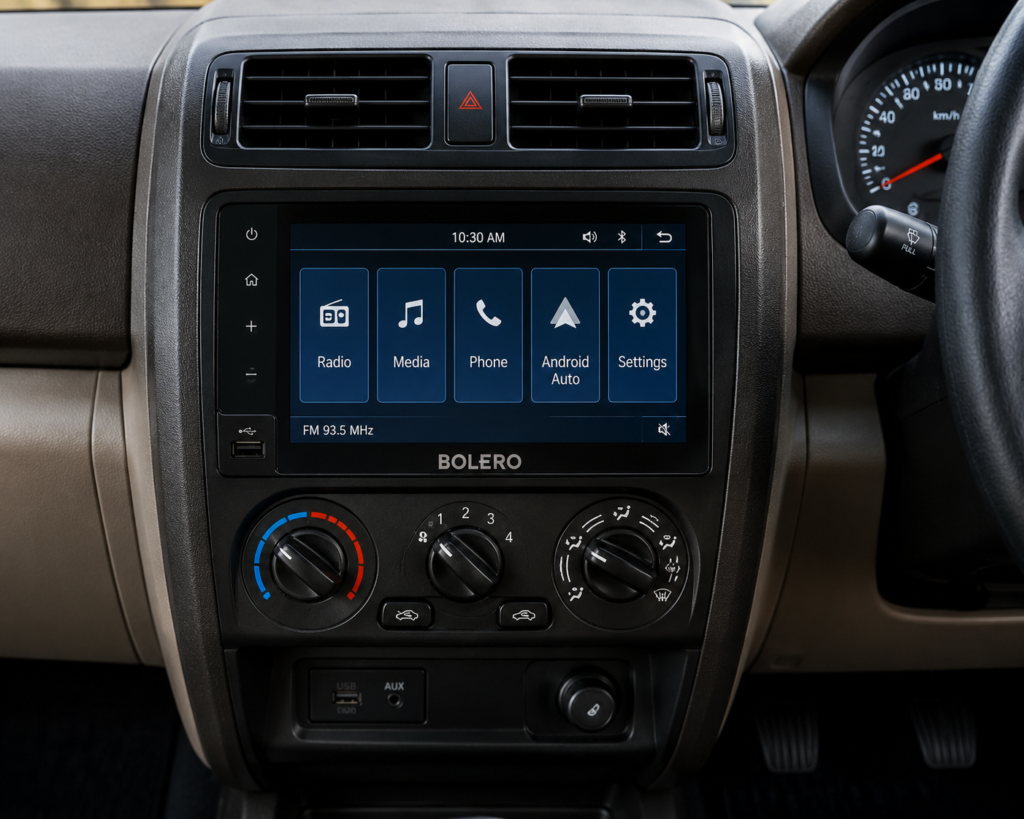
The Bolero is not a feature-loaded SUV.
That should be clear before you even walk into the showroom.
The current model does, however, offer some useful equipment depending on the variant.
Features include:
- 7-inch touchscreen infotainment system
- Steering-mounted controls
- Digital instrument display
- USB charging ports
- Type-C connectivity
- Manual air conditioning
- Rear AC vents
- Power windows
- Electric ORVMs on higher variants
- Alloy wheels on higher variants
- Leatherette upholstery on the upper variant
- Rear parking sensors
- Central locking
Mahindra Bolero Engine and Performance
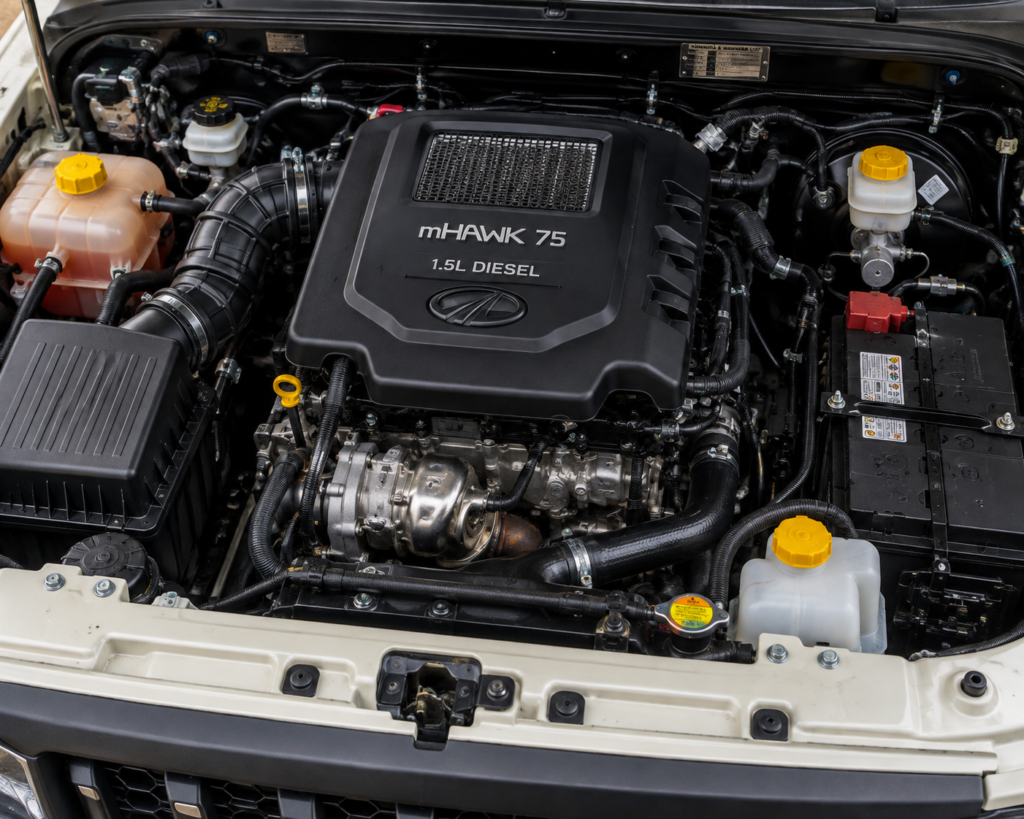
The Bolero is powered by a 1.5-litre three-cylinder turbo-diesel engine.
The engine produces approximately:
Power: 75-76hp
Torque: 210Nm
It comes exclusively with a 5-speed manual gearbox and sends power to the rear wheels.
On paper, those numbers don’t look particularly impressive.
But the Bolero isn’t about outright horsepower.
Its personality comes from the torque.
The engine develops 210Nm from around 1,600rpm, which gives the SUV a strong low-speed character.
This is exactly what you want from a vehicle that may spend a lot of time on broken roads, inclines and low-speed conditions.
How Does the Bolero Feel in the City?
The Bolero can actually be quite easy to drive in traffic once you understand its character.
The diesel engine has enough low-end torque to get the vehicle moving without constantly needing to rev it.
However, the clutch is relatively long and heavy compared with the light controls of many modern urban SUVs.
The steering also demands more effort at low speeds.
So while the engine is city-friendly, the overall driving experience isn’t particularly effortless.
If you’re used to a compact crossover with light steering, a short clutch and automatic transmission, the Bolero will feel old-school.
But if you’re accustomed to driving utility vehicles, it won’t take long to adapt.
Mahindra Bolero Highway Performance
The Bolero is comfortable cruising at sensible highway speeds.
The diesel engine has enough mid-range torque for ordinary overtaking, particularly when you’re willing to downshift.
But this isn’t a vehicle designed for high-speed cruising.
As speed rises, engine noise becomes more noticeable.
The boxy body and utility-oriented suspension also mean that the Bolero doesn’t deliver the planted, refined highway experience you get from newer monocoque SUVs.
Its ideal highway rhythm is therefore:
Cruise calmly, maintain sensible speeds and don’t expect sporty handling.
That suits its character perfectly.
Mahindra Bolero Ride Quality
The Bolero’s ladder-frame construction is one of its biggest strengths—and one of its biggest compromises.
On broken roads, the robust underpinnings allow the vehicle to shrug off conditions that might make a softer urban SUV uncomfortable.
The suspension is designed with durability and rough-road ability in mind.
But there’s a catch.
With little load onboard, the vehicle can feel bouncy and body movement becomes noticeable.
Bolero has a very specific relationship with bad roads:
It handles them confidently, but it doesn’t necessarily isolate passengers from them.
That’s an important difference.
Is the Mahindra Bolero Good for Bad Roads?
Yes—and this is arguably its strongest selling point.
The combination of:
- Ladder-frame chassis
- Rear-wheel drive
- 180mm ground clearance
- Torquey diesel engine
- Relatively simple mechanical package
- Robust suspension setup
makes the Bolero particularly suited to rough Indian roads.
This doesn’t mean it’s an extreme off-roader.
It doesn’t have the sophisticated four-wheel-drive system of a dedicated off-road SUV.
But for rural roads, broken village tracks, construction areas and poorly maintained roads, the Bolero’s basic formula remains effective.
Mahindra Bolero Mileage
The claimed mileage figure is around 16-16.5kmpl, depending on the source and methodology used.
Real-world mileage will naturally depend on:
- Traffic
- Driving style
- Passenger/load
- Road conditions
- Tyre pressure
- Maintenance
- Air-conditioning usage
For a rugged seven-seater diesel SUV, that is a respectable result.
Mahindra Bolero Safety Features
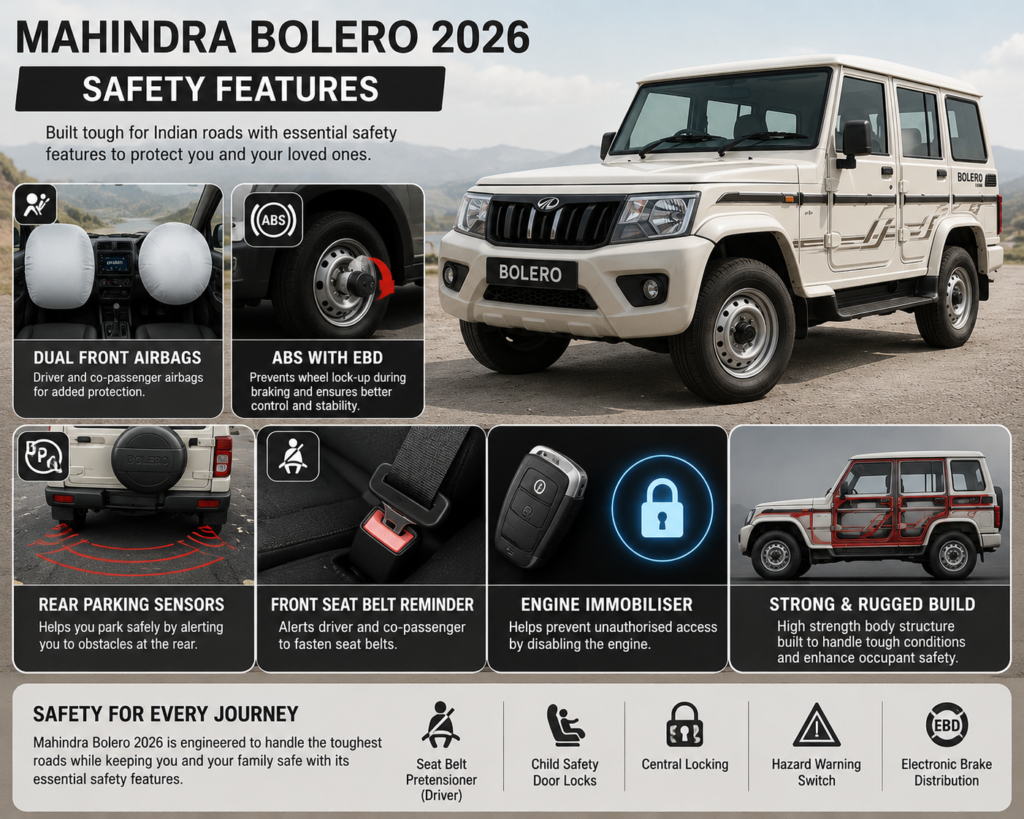
Safety is an area where the Bolero doesn’t feel as competitive as newer SUVs.
The current model includes:
- Dual front airbags
- ABS with EBD
- Rear parking sensors
- Front seat-belt reminders
- Engine immobiliser
However, buyers should not confuse the Bolero’s rugged construction with having a comprehensive modern safety package.
These are two different things.
A strong ladder-frame chassis does not automatically mean a vehicle has all the active and passive safety equipment found in newer SUVs.
The absence of more advanced safety features is therefore something buyers should consider carefully.
Another important issue is the third row.
For families, this is an important consideration.
If you regularly carry seven passengers, particularly children or elderly family members, the seating arrangement deserves careful thought.
Mahindra Bolero Variants Explained
There are four variants:
Bolero B4
The B4 is the entry point into the Bolero range.
At ₹8.49 lakh ex-showroom, it is aimed at buyers who want the basic Bolero formula without spending extra on cosmetic and convenience upgrades.
It gets the essential mechanical package along with basic safety and utility equipment.
This is the variant that makes the most sense if your priorities are:
- Durability
- Diesel engine
- Rear-wheel drive
- Low purchase price
- Utility use
Bolero B6
The B6 costs ₹9.29 lakh ex-showroom.
It adds several convenience and appearance upgrades over the base model.
For many buyers, this is the point where the Bolero starts feeling more complete.
If you are buying the vehicle for family use rather than purely commercial or utility purposes, the B6 is worth considering.
Bolero B6 Opt
The B6 Opt sits at ₹9.69 lakh ex-showroom.
It occupies an interesting position because it brings you closer to the top-spec B8 without going all the way.
For buyers who want some of the additional equipment without necessarily needing every premium feature, this can be a sensible middle ground.
Bolero B8
The B8 is the range-topping variant at ₹9.99 lakh ex-showroom.
It brings the more desirable equipment such as the touchscreen, alloy wheels, electric ORVMs, additional convenience features and upgraded upholstery.
If you’re buying the Bolero for personal family use, the B8 is arguably the most appealing variant because it removes some of the basic-car feeling.
Which Mahindra Bolero Variant Should You Buy?
For most private buyers, I would look closely at the B6 or B6 Opt before automatically choosing the cheapest model.
The B4 is attractive because of its price, but the additional equipment in the higher variants can make everyday ownership more pleasant.
The B8 is the easiest recommendation if you want the most complete Bolero experience.
But if your objective is simply:
“Give me a tough diesel SUV and I don’t care much about gadgets.”
then the B4 can be perfectly logical.
My variant recommendation:
Best value: B6
Best for utility: B4
Best balance of equipment and price: B6 Opt
Best equipped: B8
Mahindra Bolero vs Modern Compact SUVs
This is where things get interesting.
The Bolero isn’t competing purely on features.
A modern compact SUV may give you:
- Better infotainment
- More sophisticated cabin
- Lighter steering
- Better ride isolation
- More safety technology
- Petrol and automatic options
- More polished road manners
The Bolero answers with:
- Diesel torque
- Rear-wheel drive
- Ladder-frame construction
- Rugged suspension
- Simple mechanical package
- Strong low-speed pulling ability
- Excellent familiarity in rural India
So choosing between them isn’t simply about which vehicle is “better.”
It’s about which vehicle is better for your roads and your priorities.
Mahindra Bolero for Rural Buyers
This is where the Bolero makes the strongest argument for itself.
In many rural and semi-rural parts of India, road conditions are very different from those in major cities.
A vehicle may need to deal with:
- Potholes
- Mud
- Broken village roads
- Unpaved tracks
- Steep approaches
- Heavy loads
- Frequent stop-start driving
- Long distances between service locations
A vehicle that is simple, tough and mechanically familiar has an advantage in such conditions.
That’s why the Bolero’s continued popularity makes sense.
It isn’t trying to be everything to everyone.
It is good at a particular job.
Mahindra Bolero for Family Use
The Bolero can work as a family SUV, but buyers should understand the compromises.
The first two rows offer usable space, and the seven-seat configuration is useful when additional passengers need to be accommodated.
But the third-row jump seats aren’t ideal for regular passenger use.
The ride can also be bouncy, especially without much load.
So if your family spends most of its time driving inside a city and on highways, a modern monocoque SUV may provide a much more comfortable experience.
If your family lives in an area with poor roads and frequently needs a rugged vehicle, the Bolero becomes much more attractive.
Mahindra Bolero Maintenance and Ownership
One of the reasons the Bolero has built such a strong reputation is its straightforward mechanical character.
The diesel engine isn’t designed around extracting huge performance numbers.
Instead, it prioritises usable torque.
The mechanical package is also familiar to a huge number of Indian drivers and mechanics.
That matters in smaller towns.
A vehicle isn’t truly convenient if getting it repaired requires travelling hundreds of kilometres.
The Bolero’s widespread presence means parts, knowledge and service familiarity are generally easier to find than with many niche vehicles.
However, that does not mean maintenance can be ignored.
Owners should still regularly check:
- Engine oil
- Coolant
- Brake fluid
- Transmission oil
- Air filter
- Fuel filter
- Brake pads
- Tyres
- Suspension components
- Battery
- Belts and hoses
Diesel engines also benefit from being serviced according to the manufacturer’s recommended schedule.
What We Like About the Mahindra Bolero
1. Rugged construction
The ladder-frame foundation remains one of the biggest reasons people choose the Bolero.
2. Strong low-end torque
The 210Nm diesel engine works particularly well at low revs.
3. Rear-wheel drive
RWD gives the Bolero a useful character on rough roads and under load.
4. Simple nature
There aren’t too many complicated systems to distract from its basic job.
5. Recognisable styling
The Bolero looks different from almost every modern crossover.
6. Seven-seat configuration
The additional seats increase its practical flexibility.
7. Good ground clearance
The 180mm clearance helps when roads get rough.
Mahindra Bolero for Rural Buyers
This is where the Bolero makes the strongest argument for itself.
In many rural and semi-rural parts of India, road conditions are very different from those in major cities.
A vehicle may need to deal with:
- Potholes
- Mud
- Broken village roads
- Unpaved tracks
- Steep approaches
- Heavy loads
- Frequent stop-start driving
- Long distances between service locations
A vehicle that is simple, tough and mechanically familiar has an advantage in such conditions.
That’s why the Bolero’s continued popularity makes sense.
It isn’t trying to be everything to everyone.
It is good at a particular job.
Mahindra Bolero for Family Use
The Bolero can work as a family SUV, but buyers should understand the compromises.
The first two rows offer usable space, and the seven-seat configuration is useful when additional passengers need to be accommodated.
But the third-row jump seats aren’t ideal for regular passenger use.
The ride can also be bouncy, especially without much load.
So if your family spends most of its time driving inside a city and on highways, a modern monocoque SUV may provide a much more comfortable experience.
If your family lives in an area with poor roads and frequently needs a rugged vehicle, the Bolero becomes much more attractive.
Mahindra Bolero Maintenance and Ownership
One of the reasons the Bolero has built such a strong reputation is its straightforward mechanical character.
The diesel engine isn’t designed around extracting huge performance numbers.
Instead, it prioritises usable torque.
The mechanical package is also familiar to a huge number of Indian drivers and mechanics.
That matters in smaller towns.
A vehicle isn’t truly convenient if getting it repaired requires travelling hundreds of kilometres.
The Bolero’s widespread presence means parts, knowledge and service familiarity are generally easier to find than with many niche vehicles.
However, that does not mean maintenance can be ignored.
Owners should still regularly check:
- Engine oil
- Coolant
- Brake fluid
- Transmission oil
- Air filter
- Fuel filter
- Brake pads
- Tyres
- Suspension components
- Battery
- Belts and hoses
Diesel engines also benefit from being serviced according to the manufacturer’s recommended schedule.
What We Like About the Mahindra Bolero
1. Rugged construction
The ladder-frame foundation remains one of the biggest reasons people choose the Bolero.
2. Strong low-end torque
The 210Nm diesel engine works particularly well at low revs.
3. Rear-wheel drive
RWD gives the Bolero a useful character on rough roads and under load.
4. Simple nature
There aren’t too many complicated systems to distract from its basic job.
5. Recognisable styling
The Bolero looks different from almost every modern crossover.
6. Seven-seat configuration
The additional seats increase its practical flexibility.
7. Good ground clearance
The 180mm clearance helps when roads get rough.
Mahindra Bolero: Pros and Cons
| Pros | Cons |
|---|---|
| Rugged ladder-frame construction | Outdated cabin |
| Strong low-end diesel torque | Basic safety package |
| Rear-wheel drive | Heavy steering |
| Good for rough roads | Noticeable body roll |
| Seven-seat layout | Third-row seats are basic |
| Simple mechanical character | Engine can be noisy |
| Strong AC | Limited modern features |
| Familiar ownership experience | No automatic gearbox |
Is Mahindra Bolero Worth Buying in 2026?
Yes—but only for the right buyer.
This is not the SUV I would recommend simply because someone wants the latest technology or the most comfortable city driving experience.
There are newer vehicles that do those jobs better.
But if you live in an area where roads regularly become difficult, need a seven-seat vehicle, prefer diesel torque, want rear-wheel drive and value a rugged mechanical package, the Bolero continues to make a strong case.
Its biggest strength isn’t one particular specification.
It’s the combination of characteristics.
The Bolero is relatively compact, tall, rugged, diesel-powered, rear-wheel driven and simple.
That combination is becoming increasingly uncommon.
Who Should Buy the Mahindra Bolero?
The Bolero makes sense for:
- Rural families
- Semi-urban buyers
- Farmers
- Small business owners
- Buyers who frequently use rough roads
- People who need a practical seven-seater
- Buyers who prioritise durability over luxury
- Owners who prefer diesel torque
- Buyers who want a straightforward SUV
Who Should Avoid the Mahindra Bolero?
You should probably consider something else if your priorities are:
- Premium interiors
- Advanced driver-assistance systems
- Excellent highway refinement
- Automatic transmission
- Quiet cabin
- Smooth city driving
- Sophisticated infotainment
- Luxury features
- Highly comfortable third-row seating
The Bolero isn’t a bad SUV because it lacks these things.
It simply has a different purpose.
Mahindra Bolero 2026: Final Verdict
The Mahindra Bolero is an interesting example of a vehicle surviving in a market that has changed dramatically around it.
SUV buyers today are surrounded by touchscreen displays, connected-car technology, panoramic sunroofs, automatic transmissions and increasingly sophisticated safety systems.
The Bolero has none of that ambition.
Instead, it continues to say:
“Give me a rough road and I’ll deal with it.”
And that’s precisely why it remains relevant.
Its 1.5-litre diesel engine produces around 210Nm, the rear-wheel-drive layout suits its utility-oriented character, and its ladder-frame chassis remains well suited to difficult roads.
At the same time, buyers shouldn’t overlook its weaknesses.
The interior is dated. The safety equipment is basic. The third row is compromised. The ride can be bouncy. Steering effort is higher than in most modern SUVs. And highway refinement isn’t its strongest quality.
So the Bolero isn’t the “best SUV” for everyone.
It is something more specific:
A rugged Indian workhorse that has learned just enough modernity to remain relevant without abandoning its original identity.
For buyers who understand that formula, the Bolero remains one of Mahindra’s most distinctive offerings.
Frequently Asked Questions About Mahindra Bolero 2026
1. What is the price of Mahindra Bolero in India?
The Mahindra Bolero is currently priced from ₹8.49 lakh to ₹9.99 lakh ex-showroom, depending on the variant. The range includes B4, B6, B6 Opt and B8.
2. How many variants of Mahindra Bolero are available?
There are four variants: B4, B6, B6 Opt and B8.
3. What engine does the Mahindra Bolero use?
The Bolero uses a 1.5-litre three-cylinder turbo-diesel engine producing approximately 75-76hp and 210Nm of torque.
4. Does Mahindra Bolero have an automatic gearbox?
No. The current Bolero is offered with a 5-speed manual transmission.
5. Is Mahindra Bolero rear-wheel drive?
Yes. The Bolero uses a rear-wheel-drive layout.
6. How many people can sit in the Mahindra Bolero?
The Bolero is marketed as a seven-seater. However, the third-row jump seats are less comfortable and less suitable for regular long-distance use than the first two rows.
7. What is the mileage of Mahindra Bolero?
The claimed mileage is approximately 16-16.5kmpl, depending on the source. Real-world mileage will vary according to driving conditions and usage.
8. Is Mahindra Bolero good for village roads?
Yes. Its ladder-frame chassis, rear-wheel drive, diesel torque and 180mm ground clearance make it particularly suitable for rough and poorly maintained roads.
9. Is Mahindra Bolero good for highway driving?
It can handle highway driving comfortably at sensible speeds, but it isn’t designed to provide the refinement or high-speed comfort of newer urban SUVs. Engine noise and body movement become more noticeable as speed increases.
10. Does Mahindra Bolero have seven proper seats?
Not exactly. It has seven seating positions, but the third row consists of side-facing jump seats and is less comfortable than conventional forward-facing seats.
11. Is Mahindra Bolero safe?
The Bolero gets basic safety equipment including dual front airbags, ABS, EBD and rear parking sensors. However, its safety equipment is less comprehensive than that of many newer SUVs.
12. Which is the best Mahindra Bolero variant?
For most private buyers, the B6 or B6 Opt offers a good balance between price and equipment. The B8 is preferable if you want the maximum available equipment.
13. What is the cheapest Mahindra Bolero variant?
The Bolero B4 is the entry-level variant and is currently listed at ₹8.49 lakh ex-showroom.
14. What is the top model of Mahindra Bolero?
The Bolero B8 is the top-spec variant and is currently listed at ₹9.99 lakh ex-showroom.
15. Does Mahindra Bolero have a touchscreen?
Yes. The higher variant range includes a 7-inch touchscreen infotainment system.
16. Does Mahindra Bolero have Apple CarPlay and Android Auto?
The current infotainment setup is relatively basic. The system does not offer Android Auto or Apple CarPlay and instead supports phone mirroring.
17. Is Mahindra Bolero good for a family?
It can be a practical family SUV if your family regularly drives on rough roads and values durability. However, buyers looking for premium comfort, a refined third row and modern safety technology should consider newer alternatives.
18. Is Mahindra Bolero a good car for farmers?
It can be an especially suitable choice for buyers who regularly travel on rural roads, carry equipment or need a vehicle capable of handling rough surfaces. Its rugged chassis and diesel torque are well suited to this type of usage.
19. Does Mahindra Bolero have good ground clearance?
Yes. The ground clearance at 180mm, which is useful for dealing with potholes, broken roads and uneven surfaces.
20. Is Mahindra Bolero worth buying in 2026?
The Bolero is worth considering if ruggedness, simple ownership, diesel torque, rear-wheel drive and rough-road capability are your priorities. It is less suitable if your priorities are premium comfort, advanced safety technology and modern features.
Check out all Mahindra car’s & SUV’s – Click Here
Hyundai Exter Vs Maruti Fronx – Click Here
Nissan Magnite Price & Mileage – Click Here
Toyota Fortuner Review – Click Here
Car Maintenance Tips – Click Here